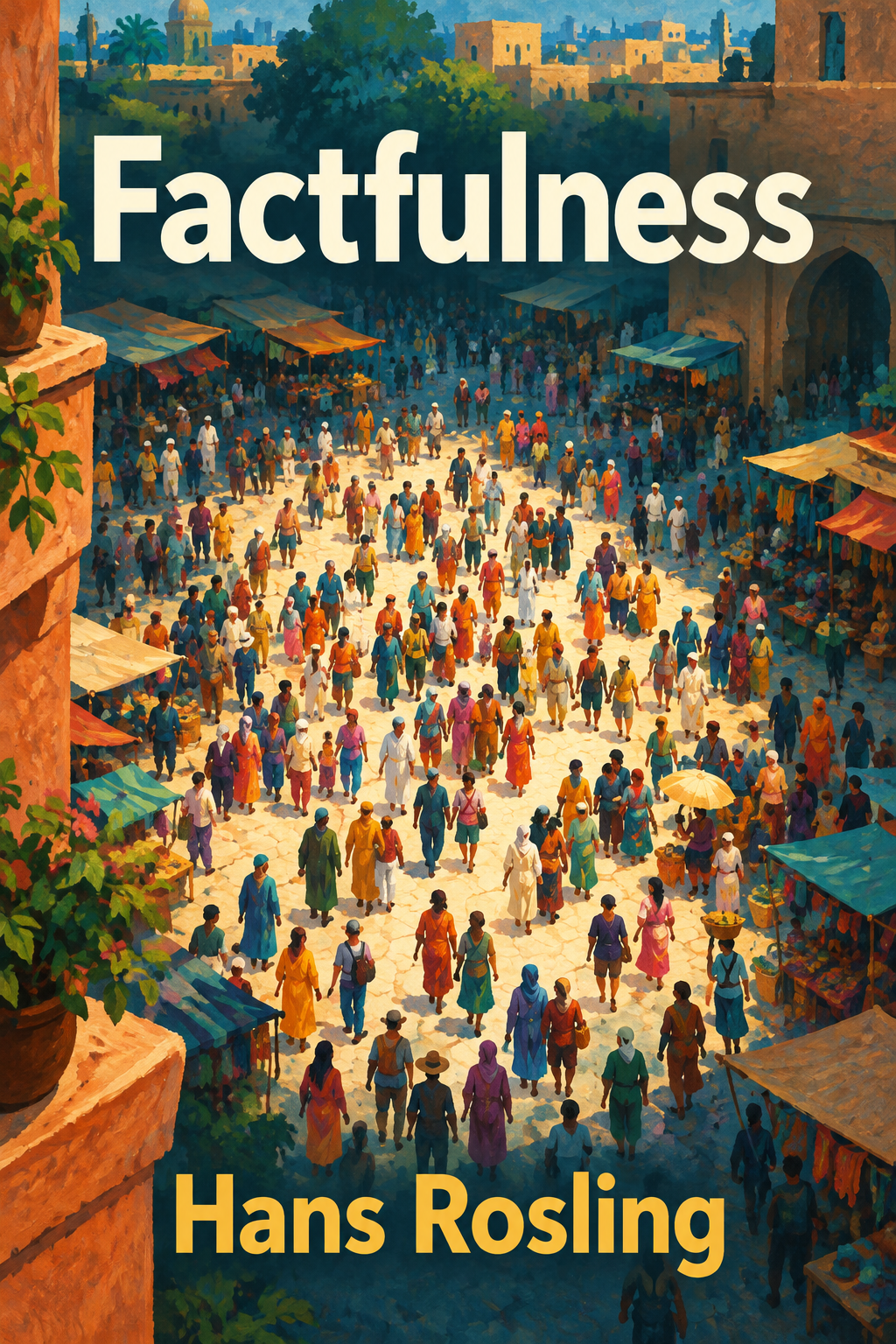
Factfulness
Tác giả: Hans Rosling
Factfulness is Hans Rosling’s guide to seeing the world as it really is. He shows that most people think the world is worse, more divided and more dangerous than the data says. Ten mental habits, which he calls instincts, explain why. Each chapter takes one instinct, gives a real example, and offers a simple check so you can correct your view. The result is a calmer, more accurate picture of global progress.
Ý Tưởng Chính
"The book argues that ten predictable thinking habits, which it calls instincts, make us misread the world. Learning to spot them lets us see facts more clearly."
Những Hiểu Biết Cốt Lõi
Most people live in the middle
The world is not split into two clean halves. Rosling’s income levels show a large middle where most people live, with smaller groups at each extreme. Once you see that, the gap between rich and poor looks less like a wall and more like a slope that people are climbing.
A policy built on the idea of ‘developed’ and ‘developing’ countries can miss the people in the middle, who need clean water, schools and steady work. Checking where most people actually sit comes first.
Progress is quiet
News rewards the sudden and the shocking, so steady gains rarely make headlines. Rosling’s point is that long-run trends in health and schooling have often moved upward, even when individual stories are grim. Holding both truths at once is the core habit of the book.
When you read about a disaster, check whether you also know the broader trend. One bad event does not automatically mean the whole system is failing.
Find the denominator
A number without a base is hard to judge. Ask ‘out of what?’ before deciding whether a figure is large or small. A ratio, a rate or a per-person figure often tells a different story than the raw total.
For example, a count of 1,000 cases means something very different in a town of 10,000 people than in a city of 10 million. Compare on the same base before you react.
Use a toolbox
A good explanation is valuable, but it becomes a trap when it is the only one you use. The book suggests looking for other tools: other data, other fields, and colleagues who disagree with you. Each lens reveals something the others hide.
If one theory says a problem has a single cause, test it against a second source of data before you accept it. If the numbers do not fit, the theory may need work.
Tóm Tắt Chương
Chapter-by-chapter summary
Spoiler warning: this section covers the whole book, instinct by instinct.
Chapter 1: The Gap Instinct
We tend to split the world into two camps, usually “rich” and “poor”, and assume a wide gap separates them. Rosling shows that most people actually live in the middle, between the two extremes. He uses income levels to show a broad middle where the bulk of the world sits. Seeing this changes the questions you ask. It matters because aid, business and policy decisions based on a split world can miss where most people really live.
Chapter 2: The Negativity Instinct
Bad news travels fast, and our brains are built to notice threats. Rosling argues that news focuses on what is sudden and dramatic, so slow, steady improvements rarely get covered. As a result, many people believe the world is getting worse when, on many measures of health and schooling, it has improved for decades. The point is not to ignore problems. It is to notice progress as well, so you can see what is working and build on it.
Chapter 3: The Straight Line Instinct
We often expect a trend to continue in a straight line forever. Rosling uses population growth as the key example: a number that is rising quickly does not necessarily keep rising at the same pace. Many curves bend and level off over time. The useful question is what a curve is doing now and where it is likely to bend, not just where it is heading if nothing changes. This habit protects us from projecting one past trend onto a future that is already different.
Chapter 4: The Fear Instinct
Our brains react strongly to sudden, frightening events, such as plane crashes or attacks, so we overestimate their danger. Rosling points out that fear pulls our attention toward the most dramatic risks, even when quieter, everyday dangers can cause more harm. The book suggests asking which risks are actually large and which are only vivid. Comparing risks by how often they cause harm helps separate real concerns from fears that feel bigger than they are. Fear is useful in an emergency, but it is a poor guide for planning.
Chapter 5: The Size Instinct
A big number on its own can mislead us. A million sounds huge, but the right question is a million out of what. Rosling asks readers to compare numbers with the right base, such as a population or a rate per person, rather than reacting to the raw total. Without that context, a number can make a small problem look enormous or a large one look trivial. Before you react to a figure, find the denominator. This simple habit makes most statistics easier to judge.
Chapter 6: The Generalization Instinct
We group people and countries into categories, then assume every member is the same. Phrases like ‘people in poor countries’ can hide huge differences in income, health and opportunity. Categories are useful, Rosling says, but they should help us understand, not replace looking at the individuals and places inside them. The better habit is to ask how common a trait really is within a group, and whether the group itself is changing over time.
Chapter 7: The Destiny Instinct
Many people believe that culture, religion or geography fixes a country’s future, so change seems impossible. Rosling argues that this view ignores how quickly societies can change. Many countries have improved their health and schooling records within a few decades, which shows that destiny is not fixed. The lesson is not that culture doesn’t matter, but that it does not decide outcomes on its own. Before you assume a place is stuck, look for evidence of change.
Chapter 8: The Single Perspective Instinct
Once we find a useful tool, we tend to use it on every problem, just as a hammer makes everything look like a nail. Rosling warns that a single lens, such as one cause or one simple theory, can explain a lot yet miss much more. His remedy is to carry a toolbox instead: several perspectives, several kinds of data, and colleagues from other fields who see things differently. Using several lenses gives a fuller picture and makes it easier to notice when your favourite explanation fails.
Chapter 9: The Blame Instinct
When something goes wrong, we look for a villain: a bad leader, a bad group or a bad person. Rosling argues that this habit hides the systems and the many small causes behind most problems. Blame feels satisfying, but it rarely leads to better solutions. The more useful question is which structures and incentives made the outcome likely, and what would change them. Looking at systems helps us act on causes rather than on whoever happens to be visible.
Chapter 10: The Urgency Instinct
Some problems are genuinely urgent, and the book does not deny that. But the urgency instinct pushes us to act before we have the facts, which can lead to rash decisions. Rosling warns that panic makes us skip the check that would show us what really matters. Instead, gather better data, ask what the real timeline is, and identify which actions would actually work. Acting quickly and acting well are not the same thing.
Key people and terms
- Hans Rosling: the lead author, a Swedish doctor and professor of global health who used data to show how the world is changing. He died in 2017, before the book was finished.
- Ola Rosling: Hans’s son and a statistician. He co-authored the book, co-founded Gapminder, and helped complete the manuscript after his father’s death.
- Anna Rosling Rönnlund: Hans’s daughter and Ola’s sister. She co-authored the book, co-founded Gapminder, and worked on turning statistics into clear visual tools.
- Gapminder: the Swedish non-profit founded by the Roslings to present world statistics through free, interactive charts and tools that help ordinary people check what they believe about the world.
- Income levels: Rosling’s way of grouping the world’s people into four levels by income. Most people sit in the middle levels, not at the extremes.
- The chimpanzee: a benchmark used in the book. Rosling compares people’s quiz answers with a chimpanzee guessing at random, to show how often people do worse than chance on basic world questions.
- The 13-question quiz: a multiple-choice quiz on basic facts about the world, used to test readers’ assumptions before the ten instincts are explained.
Writing about this book
If you need a book report, start with the change in your own thinking rather than a list of what the book says. Choose one instinct and test it against something you have seen this month. The questions below can help you find a focus. They are not a finished essay, so put the answers into your own words and your own examples.
- Which of the ten instincts do you recognise in yourself most often, and in what situation?
- Which example in the book surprised you most, and what made it surprising?
- Pick a number you have recently read. How does it look when you compare it with a population or a rate?
- When something goes wrong at school or at work, what would it take to look at the system instead of a person?
Readers can agree or disagree with Rosling’s optimism. A strong report explains which evidence would change your mind, and why.
Hành Động Ngay
Các bước thực tế bạn có thể thực hiện ngay hôm nay:
-
Before reacting to any number, ask what it is measured against. A raw total can look alarming until you compare it with the population.
-
When a news story alarms you, look for the longer trend behind it. One bad event rarely tells you whether the whole system is getting worse.
-
Ask which risks are genuinely large and which are only vivid. Dramatic dangers deserve attention, but they should not crowd out everyday risks.
-
When something goes wrong, ask which systems and incentives made the outcome likely before you look for someone to blame.
Trích Dẫn Đáng Nhớ
"“To control the gap instinct, look for the majority.” (Chapter 1)"
— Hans Rosling
"“To control the negativity instinct, expect bad news.” (Chapter 2)"
— Hans Rosling
"“To control the single perspective instinct, get a toolbox, not a hammer.” (Chapter 8)"
— Hans Rosling
"“To control the urgency instinct, take small steps.” (Chapter 10)"
— Hans Rosling
Ai Nên Đọc Cuốn Này
Anyone who reads the news, makes decisions at work or debates social issues will get something from it. It suits high school students and adult readers alike, because the examples are everyday and the vocabulary is plain. Teachers and parents who want to talk about data will find it useful too.
Về Hans Rosling
Hans Rosling was a Swedish doctor and professor of global health at Karolinska Institute. With his son Ola Rosling and daughter Anna Rosling Rönnlund, he co-founded the Gapminder Foundation to make world statistics easy to understand. He died in 2017, and his children finished Factfulness after his death.
Tóm Tắt Được Viết Bởi

Kỹ sư phần mềm & Nhà văn
Kỹ sư phần mềm với niềm đam mê chuyển đổi ý tưởng phức tạp thành hiểu biết thực tiễn. Viết về tài chính, đầu tư, khởi nghiệp và công nghệ.
Xem tất cả tóm tắt →Đánh Giá
Chưa có đánh giá nào. Hãy là người đầu tiên chia sẻ suy nghĩ của bạn!
Viết Đánh Giá
Đọc tiếp
Tóm tắt sách

educated - Tara Westover
Tara Westover
Cuốn hồi ký kể về cuộc đời của Tara Westover, một cô gái sinh ra trong một gia đình theo…

Tóm tắt sách Atomic Habits: 4 quy luật và cách bắt đầu nhỏ
James Clear
Atomic Habits trình bày vòng lặp tín hiệu, mong muốn, hành động và phần thưởng, cùng bốn quy luật thiết…
Tóm Tắt Sách Nghĩ Giàu & Làm Giàu (Think and Grow Rich)
Napoleon Hill
What if the secrets to wealth and success weren’t hidden in complex financial strategies, but within the power of your…

Tóm Tắt Sách Tâm Lý Học Tiền Bạc (The Psychology of Money)
Morgan Housel
Morgan Housel’s insightful exploration of how psychology affects our financial decisions and wealth-building journey.
Bài Viết

Let Them Theory và phân tách nhiệm vụ: trách nhiệm bắt đầu từ đâu
Let Them Theory và phân tách nhiệm vụ đều khuyên bạn ngừng kiểm soát lựa chọn của người khác, nhưng…

Scout Mindset và tư duy phát triển: niềm tin và năng lực
Scout Mindset kiểm tra niềm tin bằng bằng chứng; tư duy phát triển nói về khả năng rèn năng lực.…

Lặp lại ngắt quãng và đọc lại: Cách ôn tập sách hiệu quả
So sánh chi tiết giữa lặp lại ngắt quãng và đọc lại thụ động. Hướng dẫn cách thiết lập các…