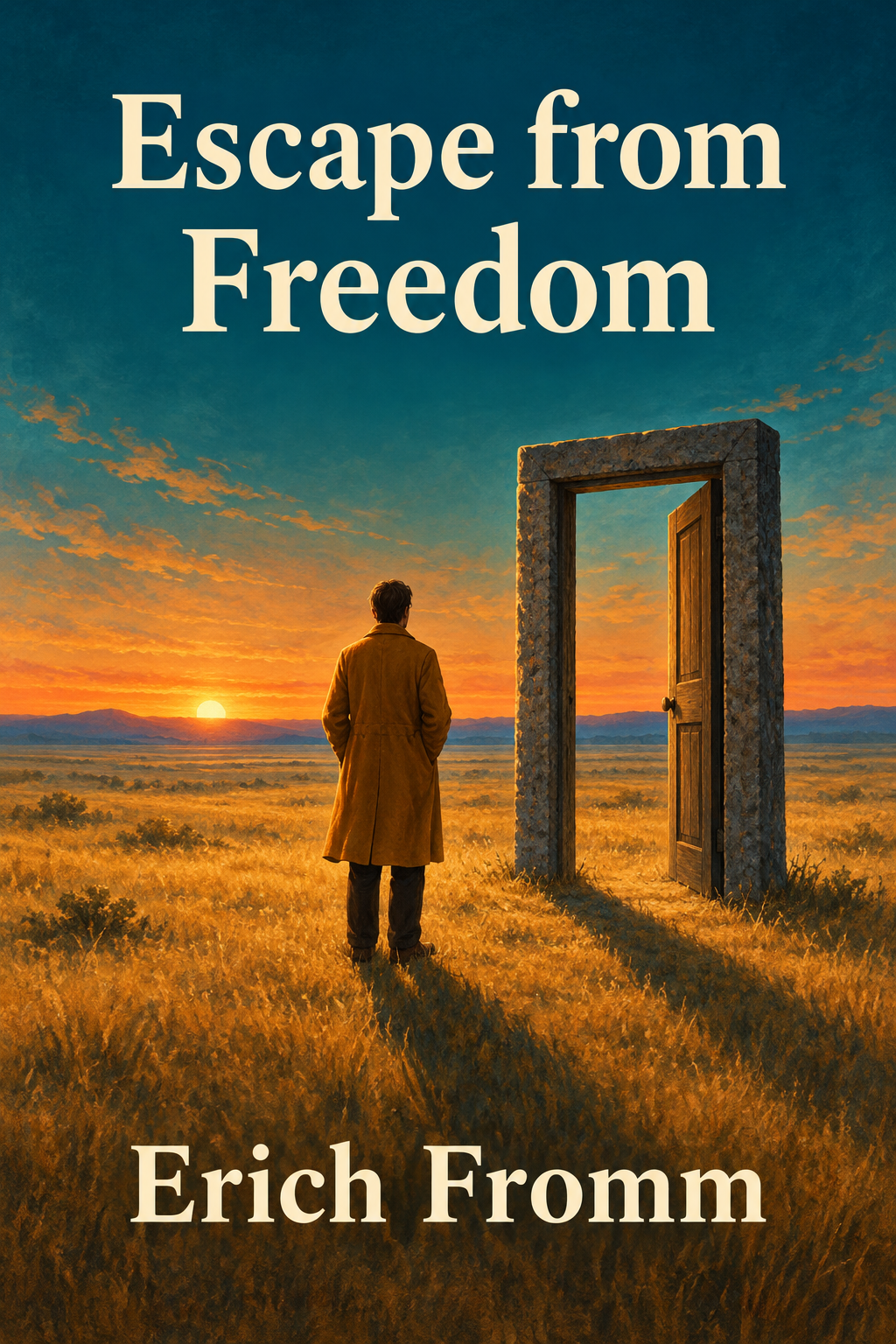
Escape from Freedom
Tác giả: Erich Fromm
Erich Fromm's Escape from Freedom asks a puzzling question: why would people who had finally won personal freedom give it up for strong leaders, conformity or even cruelty? Fromm, a German-born psychoanalyst writing in exile, applies his answer to Nazi Germany and to modern society. Freedom from old ties can leave people lonely and anxious, and many then escape into submission, domination or sameness. The lasting answer, he says, is positive freedom: acting spontaneously from one's own integrated self, especially through love and meaningful work.
Ý Tưởng Chính
"Freedom from old ties can leave people isolated and afraid. Fromm argues that the real way out is positive freedom: acting spontaneously from one's integrated self."
Những Hiểu Biết Cốt Lõi
Freedom can feel like a burden
Fromm's central surprise is that freedom does not automatically make people happy. Once old ties are gone, a person must choose, decide and carry the consequences alone, and for many that loneliness is harder to bear than the restrictions it replaced. Fromm does not treat this anxiety as weakness. He sees it as a natural response to a freedom that has not yet become an active life.
For example, someone who leaves a family business to start their own company may feel exhilarated at first, then lost when nobody tells them what to do next.
Escape routes bring relief but cost the self
Authoritarianism, destructiveness and automaton conformity all reduce anxiety quickly. Submitting to a leader removes the need to decide. Lashing out removes the feeling of helplessness. Copying the crowd removes the fear of standing alone. Fromm's point is that each route trades part of the self for a feeling of safety. Because the relief does not solve the underlying problem, people often need more of the same escape.
For example, a worker who feels powerless may adopt the loudest opinions in the room. It feels like belonging, but their own judgement goes unused.
Society shapes character
Fromm argues that economic and social systems do more than set rules. They shape the feelings and habits of the people who live inside them. A system that rewards competition and leaves people to face the market alone can produce anxious, dependent or hostile characters. That is why Fromm analyses psychology and social structure together. Laws alone are not enough; people also need roles in which they can act and feel that they matter.
For example, a workplace that judges each person by a single number may push people to please the boss rather than do work they care about.
Escape can spread through a whole society
Chapter 6 shows that the same mechanisms can work across a whole nation. When a group feels its place in society slipping, a strong leader, the persecution of minorities and a loud promise of national pride can offer a quick sense of belonging. Fromm treats this as a response that social conditions and insecurity produce in ordinary people, not only the work of a few unusually cruel individuals. Recognising the pattern is the first step toward resisting it.
For example, a community that feels its status is slipping may find a loud promise of national pride more comforting than a careful plan for the future.
Spontaneous activity is the way forward
The book's answer is not a return to the old world of fixed roles. Fromm argues that the healthy alternative is positive freedom: acting from one's integrated self, with love and creative work as its main expressions. A person who acts spontaneously does not need to submit, dominate or disappear into the crowd, because their sense of self rests on what they do and whom they care for. Fromm offers no simple recipe.
For example, someone who learns a craft for its own sake and shares it with others is acting from their own interests rather than a path set by others.
Tóm Tắt Chương
Chapter-by-chapter summary
The book moves in a clear order. It asks the question, traces the rise of the modern individual, names three escape routes, applies them to Nazi Germany, and then describes a way forward. Each chapter below gives what Fromm argues and why it matters for the rest of the book.
Chapter 1: Freedom: A Psychological Problem?
Fromm opens with a question that sounds simple: is freedom mainly a political or economic matter, or is it also something inside people? He argues that the wish to be free is among the strongest human drives, so it is strange that many people seem willing to give their freedom away. To understand this, he says, we need psychology as well as history. A society's laws and markets matter, but so do the feelings they produce in the people who live under them. Why it matters: this shift from politics to the inner life is the key that opens the rest of the book.
Chapter 2: The Emergence of the Individual and the Ambiguity of Freedom
Fromm traces how the modern individual slowly emerged. As the medieval order loosened, people gained room to think, choose and act for themselves. Family, church and village had once settled where a person belonged, and those bonds grew weaker. This was real progress, but it came at a cost. A person freed from these ties could also feel alone, unanchored and small. Fromm calls this the ambiguity of freedom: it liberates people and isolates them at the same time. Why it matters: the freedom people fought for can become so heavy that they are tempted to hand their choices to someone else.
Chapter 3: Freedom in the Age of the Reformation
Fromm looks at how the Reformation changed a person's relationship with God. Martin Luther taught that the believer stands alone before God, with faith as the only support. Fromm reads this as a source of new inner freedom and also of deep anxiety. John Calvin went further, teaching that God had already decided who would be saved, so good works could not earn salvation. Fromm argues that people responded by searching for signs of their worth in hard work and worldly success. Why it matters: this anxious drive to prove oneself reappears in the modern economy that the book studies next.
Chapter 4: The Two Aspects of Freedom
Fromm turns to modern capitalism. People were freed from feudal obligations and became free to sell their labour, move and compete. Yet most must take jobs they did not choose and face markets they cannot control, which leaves many feeling powerless. Fromm describes two sides of freedom. Freedom from is release from traditional bonds. Freedom to is the ability to act on one's own real wishes, to create, and to engage with others actively. The first can be won fairly quickly; the second is much harder. Why it matters: a person can have freedom from and still lack freedom to, and the gap between them is where anxiety grows.
Chapter 5: The Mechanisms of Escape
This is the centre of the book. Fromm names three ways people try to escape the isolation and anxiety that freedom brings. The first is authoritarianism: merging with a stronger power, either by submitting to it or by dominating others. Fromm illustrates this through sadism and masochism. The second is destructiveness, which tries to remove the feeling of powerlessness by destroying whatever seems to threaten the self. The third is automaton conformity: becoming exactly like the people around you and taking on the personality the culture offers. Each route brings relief, Fromm argues, but none gives the person what they actually need. Why it matters: these mechanisms explain how people drift toward movements that offer certainty and belonging at the cost of their own freedom.
Chapter 6: The Psychology of Nazism
Fromm turns his three escape routes into a case study of Nazism. He draws heavily on Hitler's autobiography, Mein Kampf, to read the psychology of the leader and of the movement he built. His particular focus is the German lower middle class, whose economic and social position had been losing ground for years, even before the First World War. Many of its members felt insecure and powerless. They found relief in submitting to a strong leader, in the persecution of minorities and in a sense of belonging to the nation. Fromm argues that these responses are the same escape routes described in Chapter 5. Why it matters: the chapter shows that the escape from freedom can spread through a whole society, not only through a few individuals.
Chapter 7: Freedom and Democracy
Fromm asks what a democracy must offer if people are not to escape their freedom. Political rights such as voting and free speech matter, but he argues they are not enough when people feel powerless in their daily work and private lives. He also examines what he calls the illusion of individuality: many people believe they think and choose for themselves, while the culture supplies much of what they think and want. The alternative he describes is spontaneity, which means acting from one's whole, integrated self rather than from pressure, fear or the crowd. Love and productive work are its clearest forms. Why it matters: the book's answer is not a return to old certainties. It is a fuller freedom that a person can actually live.
Appendix: Character and the Social Process
The book closes with a short appendix that states the theory behind the whole argument. Fromm holds that social character forms as human nature adapts to the structure of a society. When social conditions change, the needs and anxieties of the people living in them change too. This is why the escape routes are not only private problems. They are shaped by the society in which people live, and they can shift as that society shifts.
Key people and terms
- Freedom from and freedom to: Fromm's two sides of freedom. Freedom from is release from old bonds such as feudal ties or church authority. Freedom to is the capacity to act on one's own real wishes, create and relate to others. The gap between them drives the book's argument.
- Ambiguity of freedom: the idea from chapter 2 that freedom both frees people from old ties and leaves them isolated and anxious. Fromm calls this two-sided quality the ambiguity of freedom.
- Reformation: the sixteenth-century movement that questioned the church and the nature of faith. Fromm uses it to show how religious teaching came to shape a person's inner sense of isolation.
- Martin Luther and John Calvin: the two Reformation thinkers Fromm uses to show how religious teaching shaped an inner sense of isolation and an urge to prove one's worth. Luther left the believer alone before God. Calvin's doctrine of predestination intensified the search for signs of being chosen.
- Adolf Hitler: the Nazi leader whose autobiography, Mein Kampf, Fromm uses as a main source in Chapter 6. Fromm reads his need to dominate, and his hostility toward minorities, as a clear case of the authoritarian character the book describes.
- Authoritarianism: the first escape route. People merge with a stronger power, either by submitting to it or by dominating others. Fromm describes this through sadism and masochism, two sides of the same need to depend on or control another person.
- Sadism and masochism: the pair of needs Fromm uses to explain authoritarianism. One seeks to control another person, and the other seeks to submit to them. Fromm sees both as ways of avoiding the anxiety of standing alone.
- Destructiveness: the second escape route. It tries to get rid of powerlessness by attacking or destroying whatever seems to threaten the self. Fromm treats it as an escape rather than a natural strength.
- Automaton conformity: the third escape route. A person gives up their own self and becomes like everyone else, taking on the thoughts and feelings the culture offers as their own. The result is a sense of belonging without real choice.
- Spontaneity: Fromm's term for positive freedom, the active expression of the whole, integrated personality. It is not impulse or whim. It is action that comes from a person's own inner self, with love and creative work as its clearest forms.
- Love and creative work: the two areas Fromm points to as the clearest examples of spontaneous activity. Both involve engaging with others or with the world actively, rather than acting from pressure or fear.
Applying the ideas in daily life
Fromm’s book is not a self-help manual, but its questions are practical. Start with a simple check. When you make a choice, ask whether you actually want it, or whether you are following a crowd, a leader or a habit you never examined. That one question shows a great deal about the difference between freedom from and freedom to.
Next, notice your own escape routes. When you feel small or anxious, do you look for a stronger authority to decide for you, pick a fight with someone you see as a threat, or quietly adopt whatever opinions are around you? Naming the habit is the first step toward choosing differently, even if the change is small.
Finally, look for places where you can act spontaneously. Creative work, honest friendships and tasks you care about give the self something solid to stand on. Fromm’s central claim is that freedom becomes real when it is used, not only when it is granted. You do not need to change everything at once; regular, small acts of real choice are how that becomes a life.
Hành Động Ngay
Các bước thực tế bạn có thể thực hiện ngay hôm nay:
-
Before a big decision, ask whether the choice is yours or borrowed from the crowd.
-
Notice when you feel powerless and what you reach for to escape that feeling, even when it is subtle.
-
Look beyond freedom from rules and ask where you have the freedom to act, create and care for others.
-
Put your energy into work and relationships where you can act from your own values and not from pressure.
-
Write down the opinions you have reached yourself and the ones you picked up from others, and keep them apart.
Trích Dẫn Đáng Nhớ
"“positive freedom consists in the spontaneous activity of the total, integrated personality.” (Chapter 7, Freedom and Democracy)"
— Erich Fromm
"“Love is the foremost component of such spontaneity.” (Chapter 7, Freedom and Democracy)"
— Erich Fromm
"“the artist can be defined as an individual who can express himself spontaneously.” (Chapter 7, Freedom and Democracy)"
— Erich Fromm
Ai Nên Đọc Cuốn Này
Anyone who has wondered why people follow strong leaders or the crowd will find this book useful. It suits upper high school students who read comfortably and adult readers interested in psychology, politics or history. The chapters on the escape mechanisms are the densest, so take them slowly.
Về Erich Fromm
Erich Fromm (1900–1980) was a German-born psychoanalyst and social philosopher. He left Nazi Germany and settled in the United States, where he wrote Escape from Freedom. He is known for linking psychoanalysis with the study of society, asking how social conditions shape the inner lives of ordinary people.
Tóm Tắt Được Viết Bởi

Kỹ sư phần mềm & Nhà văn
Kỹ sư phần mềm với niềm đam mê chuyển đổi ý tưởng phức tạp thành hiểu biết thực tiễn. Viết về tài chính, đầu tư, khởi nghiệp và công nghệ.
Xem tất cả tóm tắt →Đánh Giá
Chưa có đánh giá nào. Hãy là người đầu tiên chia sẻ suy nghĩ của bạn!
Viết Đánh Giá
Đọc tiếp
Khám phá chủ đề: Phát triển bản thânTóm tắt sách

educated - Tara Westover
Tara Westover
Cuốn hồi ký kể về cuộc đời của Tara Westover, một cô gái sinh ra trong một gia đình theo…

Tóm tắt sách Atomic Habits: 4 quy luật và cách bắt đầu nhỏ
James Clear
Atomic Habits trình bày vòng lặp tín hiệu, mong muốn, hành động và phần thưởng, cùng bốn quy luật thiết…
Tóm Tắt Sách Nghĩ Giàu & Làm Giàu (Think and Grow Rich)
Napoleon Hill
What if the secrets to wealth and success weren’t hidden in complex financial strategies, but within the power of your…

Tóm Tắt Sách Tâm Lý Học Tiền Bạc (The Psychology of Money)
Morgan Housel
Morgan Housel’s insightful exploration of how psychology affects our financial decisions and wealth-building journey.
Bài Viết

Let Them Theory và phân tách nhiệm vụ: trách nhiệm bắt đầu từ đâu
Let Them Theory và phân tách nhiệm vụ đều khuyên bạn ngừng kiểm soát lựa chọn của người khác, nhưng…

Scout Mindset và tư duy phát triển: niềm tin và năng lực
Scout Mindset kiểm tra niềm tin bằng bằng chứng; tư duy phát triển nói về khả năng rèn năng lực.…

Lặp lại ngắt quãng và đọc lại: Cách ôn tập sách hiệu quả
So sánh chi tiết giữa lặp lại ngắt quãng và đọc lại thụ động. Hướng dẫn cách thiết lập các…