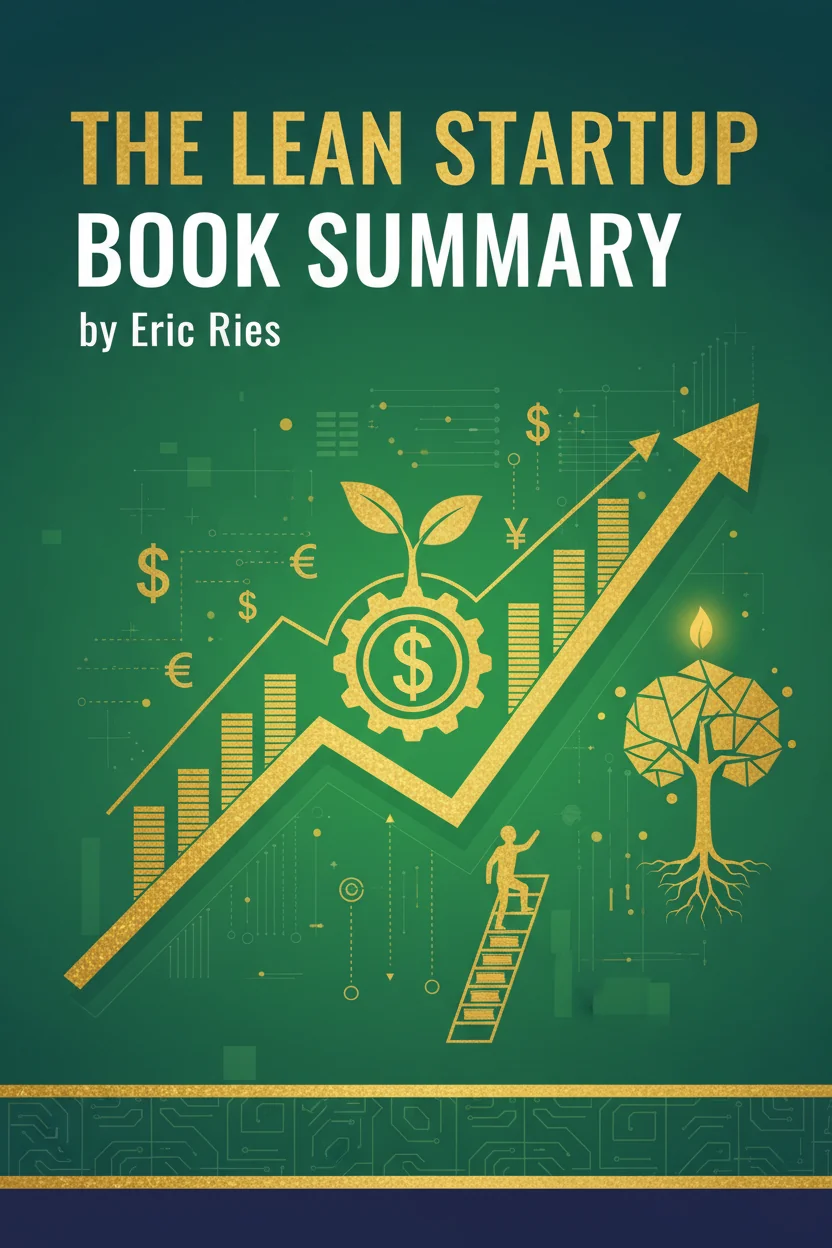
リーン・スタートアップ
による Alex Ng
検証済み学習と迅速な反復プロセスを通じて、成功するスタートアップを構築するためのエリック・リースによる革新的なアプローチ。
核心的なアイデア
"スタートアップとは単なる「規模の小さい会社」ではなく、「持続可能なビジネスモデルを探索する組織」である。成功の鍵は、完璧な計画の実行ではなく、迅速な実験による「検証済み学習」を繰り返し、重要な指標を測定し、必要に応じて方向転換(ピボット)することにある。"
重要な洞察
Build-Measure-Learn
The fundamental activity of a startup is to turn ideas into products, measure customer responses, and learn whether to pivot or persevere. Minimize the total time through this feedback loop to accelerate learning.
Instead of spending a year building a perfect product, build a minimum viable product in weeks. Measure how customers actually use it. Learn from real behavior, not hypothetical preferences.
Minimum Viable Product (MVP)
The MVP is the smallest thing you can build to start the learning loop. It's not a minimal product - it's maximum learning for minimum effort. The goal is to test assumptions, not to build features.
Dropbox's MVP was a 3-minute video showing how the product would work. It tested whether people wanted the product before building it. The signup list went from 5,000 to 75,000 overnight.
Validated Learning
Progress is not lines of code or features shipped - it's validated learning about what customers actually want. If you build something nobody wants, nothing else matters. Learning is the only essential measure of progress.
IMVU tested features rapidly by shipping incomplete products. A feature that customers ignored was learning: that assumption was wrong. A feature they loved was validation: build more of that.
Pivot or Persevere
Based on learning, startups must decide whether to pivot (change a fundamental hypothesis) or persevere (stay the course). Pivots aren't failures - they're course corrections based on evidence.
YouTube started as a video dating site. When they noticed people uploading all kinds of videos, they pivoted. Twitter (originally Odeo, a podcasting company) pivoted when iTunes dominated podcasting.
章ごとの解説
The Problem with Traditional Planning
Traditional business planning assumes you know what customers want. Startups operate under extreme uncertainty - you don't know who your customer is, what they want, or how to deliver it profitably. Planning in the face of such uncertainty is fantasy.
The Build-Measure-Learn Loop
The core activity of a startup is turning ideas into products, measuring customer response, and learning whether to pivot or persevere. Speed through this loop is the competitive advantage. Everything that doesn't contribute to learning is waste.
Minimum Viable Product
Build the simplest thing that tests your hypothesis. The MVP isn't about minimal features - it's about maximum learning. If you're not embarrassed by your first version, you launched too late.
Innovation Accounting
Traditional accounting doesn't work for startups. You need metrics that measure learning: customer acquisition, activation, retention, referral, revenue. Focus on actionable metrics (what to do differently) not vanity metrics (what looks good).
Pivot or Persevere
At regular intervals, evaluate your progress. Are you learning? Are you moving toward a sustainable business? If not, consider a pivot - a structured course correction. Types include zoom-in (one feature becomes the product), zoom-out (product becomes one feature), customer segment, platform, and many others.
アクション
今日から実践できるステップ:
-
Identify your riskiest assumptions and test them first, before building more
-
Define what success looks like before launching an experiment - what would you need to see to continue?
-
Build the smallest possible thing that tests your core hypothesis
-
Schedule regular 'pivot or persevere' meetings to evaluate whether your strategy is working
要約作成者
Software Engineer & Writer
Software engineer with a passion for distilling complex ideas into actionable insights. Writes about finance, investment, entrepreneurship, and technology.
すべての要約を見る →レビュー
レビューはまだありません。最初のレビューを書きましょう!