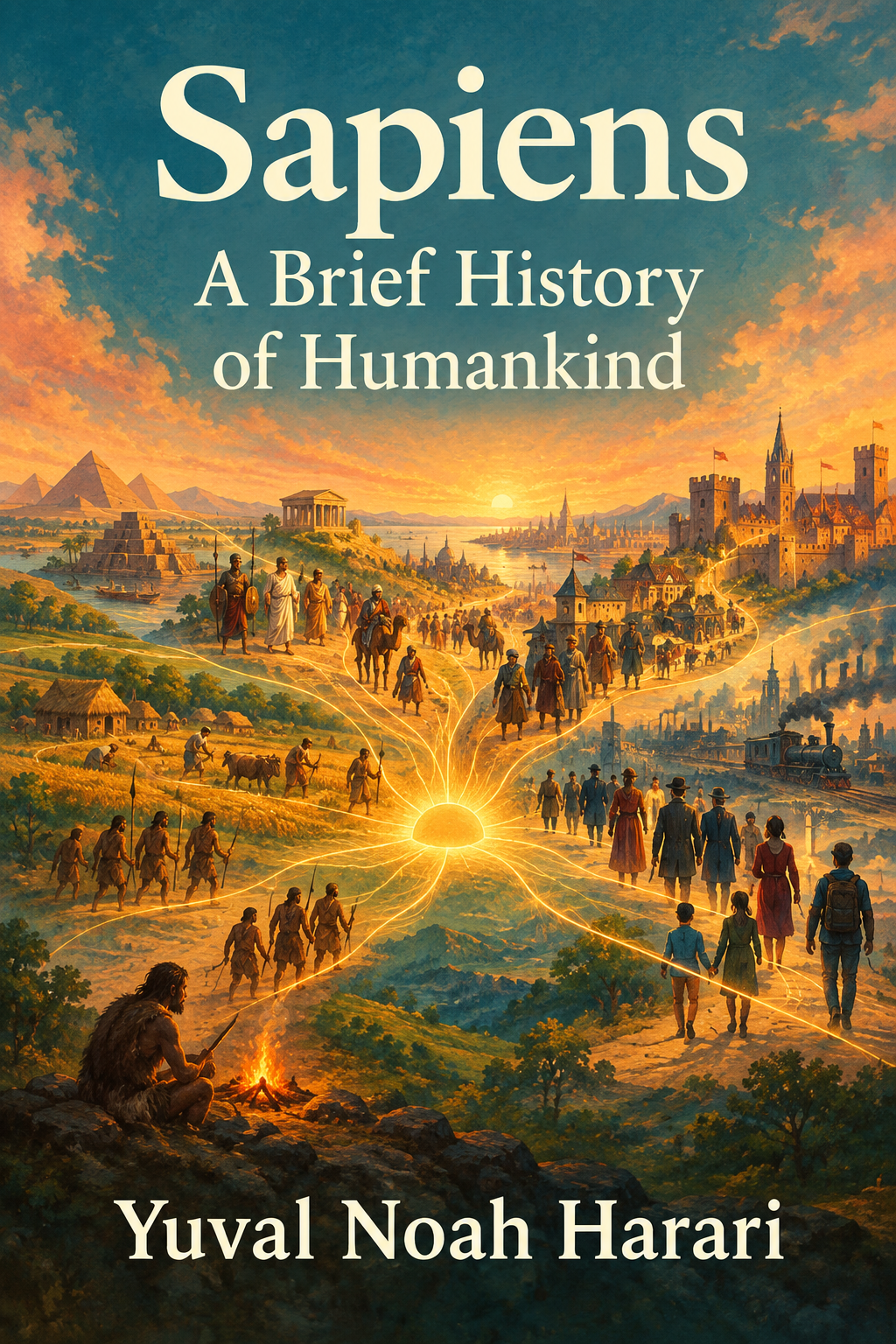
Sapiens: A Brief History of Humankind
par Yuval Noah Harari
Sapiens is a sweeping history of humankind, from the first Homo sapiens to the modern world. Yuval Noah Harari argues that three revolutions shaped us: the Cognitive Revolution, when people learned to share myths; the Agricultural Revolution, when farming took hold; and the Scientific Revolution, which began with admitting what we do not know. The book asks why an ordinary ape came to rule the planet, and whether that rule has made people happier.
L'idée principale
"Harari argues that Homo sapiens came to dominate the planet largely because shared stories such as money, nations and religions let strangers cooperate at scale."
Aperçus clés
Shared stories make large-scale cooperation possible
Harari argues that humans cooperate with strangers because they share beliefs in gods, nations, companies and currencies. Most animals cooperate only within small groups they know personally. Sapiens can organise millions of people who never meet, because they hold the same stories. Harari treats this as the engine behind empires, markets and religions alike.
A banknote has value only because millions of people accept it, so you can trade with a stranger you will never see again.
Progress for some is not a better life for all
Harari argues that the Agricultural Revolution increased what the land could produce, but it did not make most individuals healthier or freer. Farming tied people to fields and long hours, and it made hunger more likely in bad years. Meanwhile, a small number gained wealth and power. The book keeps returning to that gap.
A farming family could raise more children than a foraging band, but every harvest demanded more work from everyone in the household.
Admitting ignorance drove the scientific revolution
Harari argues that modern science began when Europeans accepted that they did not know everything, and that this humility made new knowledge possible. Science did not change the world alone, though. It joined empires that wanted new territories and a capitalist belief that growth should never end. Together they reshaped the world faster than any earlier change.
Research funded by rulers and merchants was often aimed at new markets and territories, so knowledge served expansion as well as understanding.
Détail des chapitres
Chapter-by-chapter summary
Spoiler warning: this section covers the whole argument, including its conclusions.
Part One: The Cognitive Revolution, chapters 1–2
Chapter 1: An Animal of No Significance. Harari starts with Homo sapiens as one of several human species that once shared the planet, not an obviously special one. Early Sapiens left a small footprint, and nothing about its early life hinted at what was coming. The chapter poses the book's central puzzle: how an ordinary animal came to shape the world? Its answer begins with a surprise. The edge came not from a strong body but from what the species could do together.
Chapter 2: The Tree of Knowledge. Around 70,000 years ago, Sapiens gained the ability to talk about things with no physical form, such as gods, nations and tribal myths. Harari argues that this let huge numbers of strangers cooperate. Gossip works only inside a small circle, but shared stories can bind millions of people who will never meet. The title echoes Genesis, but the chapter is about language and cognition. Here the book's central idea first appears: shared fictions drive human cooperation.
Part One: The Cognitive Revolution, chapters 3–4
Chapter 3: A Day in the Life of Adam and Eve. Harari uses one day in a forager's life to show how most people lived for most of the past. Foragers knew their surroundings in detail, moved with the seasons and tended toward fairly equal social arrangements, though life could also be violent. The title alludes to the biblical pair, but the chapter describes foragers in general. Many modern instincts and habits, he suggests, were shaped in that long past, long before cities and states existed.
Chapter 4: The Flood. Harari traces how Sapiens spread across the globe and, with it, a long wave of extinctions. Megafauna, the large animals, disappeared from Australia, the Americas and other regions. He attributes much of that loss to hunting and to land-burning that began long before the industrial age. The title is a metaphor for that wave of loss, not a literal deluge. Harari treats it as an early cost of human expansion, one that later chapters echo across history.
Part Two: The Agricultural Revolution, chapters 5–6
Chapter 5: History's Biggest Fraud. Harari's most provocative claim is that farming, which began about 12,000 years ago, was a poor bargain for most individuals. Foragers moved with the seasons and ate a varied diet. Farmers worked longer, relied on a few crops and faced hunger when harvests failed. Farming did enlarge populations and gave rise to villages, cities and states, so the gain was real for the species. The word “fraud” is figurative: farming favoured numbers over comfort, not deliberate deception.
Chapter 6: Building Pyramids. This chapter explains how large societies rest on abstract systems such as laws, nations and rights. These systems exist only because people agree to believe in them, yet they shape what people want and how they behave every day. The title points to how shared myths and social rank let strangers build huge projects together. Harari's point is that these constraints are real even though the systems are invented, which is why they are hard to step outside.
Part Two: The Agricultural Revolution, chapters 7–8
Chapter 7: Memory Overload. As communities grew, people needed to track more information than any one memory could hold. Harari describes how record-keeping began with accounts of goods and debts in early cities, and how writing changed the way societies organised knowledge. Larger societies, he argues, needed new tools as well as more people. Writing was a tool of cooperation that reshaped the societies that used it. A practical invention for accounting ended up changing how a whole society thought.
Chapter 8: There Is No Justice in History. Harari argues that the idea that some people are naturally superior to others is an imagined order, not a natural fact. Hierarchies arose through historical accidents and were then justified by stories about order and justice. Gender hierarchies are among the examples discussed in detail. The title can be read as a descriptive claim: history itself does not contain justice. Readers are asked to test the rank and fairness assumptions they take for granted.
Part Three: The Unification of Humankind, chapters 9–11
Chapter 9: The Arrow of History. Harari describes a long drift from many small, separate cultures toward fewer, larger and more connected systems. Money, empires and religions linked once-separate groups, and each carried tensions of its own. He treats this as a slow process rather than a sudden break. The chapter spans thousands of years of change. That question frames Part Three and keeps the costs of unification in view alongside its benefits: who gains and who pays as networks grow.
Chapter 10: The Scent of Money. Money works because people trust its value, even when they never meet the other party to a deal. Harari traces money from early tokens to today's electronic records. He argues that shared trust lets strangers trade across languages and borders. The chapter gives the book's clearest example of a shared fiction at work, since a coin or banknote has little worth in itself. The lesson is that a plain fact of life can depend on collective belief.
Chapter 11: Imperial Visions. Empires have repeatedly united diverse peoples under one rule, mixing languages, cultures and borders. Harari examines how empires spread common languages, laws and economic habits across wide areas, often by force. He asks what empires offered ordinary people and what they took, and does not treat the answer as simple. The chapter suggests that empires relied on shared rules and trade as well as force. It shows how the networks described in Part Three were built and held together.
Part Three: The Unification of Humankind, chapters 12–13
Chapter 12: The Law of Religion. Harari defines religion broadly, as a system of norms and values based on belief in a superhuman order. On this definition, ideologies such as liberalism, communism and nationalism count as religions too. He notes that religion, like money and empires, helped unify humankind by lending social orders higher authority. The chapter also describes how people blend contradictory beliefs into a personal worldview. Readers can test the definition by asking which of their own shared beliefs work like a religion.
Chapter 13: The Secret of Success. This chapter challenges the idea that history moves in a straight line toward progress or moral improvement. Harari argues that outcomes which look inevitable in hindsight often depended on chance and on power. He warns against this hindsight view, which treats the past as if it could only have turned out one way. The chapter invites readers to ask what else could have happened. Its lesson is to be wary of any neat story told after the fact.
Part Four: The Scientific Revolution, chapters 14–16
Chapter 14: The Discovery of Ignorance. Harari argues that modern science began when Europeans admitted they did not know everything. The revolution, he suggests, was less about new knowledge than about humility in the face of ignorance. The chapter also shows how research became tied to practical power, so science, politics and the economy began to reinforce one another. Harari treats this humility as central to the Scientific Revolution. The chapter matters because it opens Part Four and sets up its main theme.
Chapter 15: The Marriage of Science and Empire. European science in the early modern period became closely tied to imperial expansion. Exploration and colonisation supplied new data, and research funded by rulers and merchants was often aimed at new markets and territories. Science also helped justify conquest, so knowledge served expansion as well as understanding. Harari's point is that the revolution changed the world through its alliance with power, not through science alone. Readers can use it to test the assumption that knowledge is always neutral.
Chapter 16: The Capitalist Creed. Harari frames capitalism as a belief system built on expectations of future growth, credit and trust. Investment and trust-based finance drove expansion, and the belief that tomorrow should be richer than today became a creed. The chapter also shows that this system produced inequality alongside growth. The creed explains why endless growth feels so normal today. Readers may find it useful to ask which of their own plans assume that the future will be richer than the present.
Part Four: The Scientific Revolution, chapters 17–20
Chapter 17: The Wheels of Industry. The Industrial Revolution changed how humans capture and use energy. Mechanised production and consumer culture turned the belief in growth into a daily routine. Harari also criticises how industrial systems treat animals, arguing that the costs of productivity fall on other animals as well as on people. The chapter links the capitalist creed to everyday habits of working, buying and producing. It is a bridge between the economic argument of Chapter 16 and the reflections on modern life that follow.
Chapter 18: A Permanent Revolution. Harari describes a world in which change never stops and old certainties keep giving way. States and markets took over roles once held by families and local communities. Individuals gained new freedoms but often lost the social bonds that had once held them in place. The chapter presents modern life as a permanent revolution, a process that never settles. Readers are left with a practical question: when old bonds weaken, what do people gain and what do they lose?
Chapter 19: And They Lived Happily Ever After. The title is ironic. Harari asks whether all this progress has made people happier. He suggests that happiness tends to return to a baseline after big gains or losses, so more wealth and comfort do not clearly bring more contentment. The chapter tests the book's question about progress against the simplest measure of a good life: whether people feel better. Its tone is more sceptical than the earlier chapters, which is why it works as a counterweight.
Chapter 20: The End of Homo Sapiens. Harari argues that biological engineering, cyborg engineering and the creation of non-organic life could change the course of human development. In this view, evolution moves beyond natural selection, and Homo sapiens could become a transitional stage. He suggests that society as a whole should try to influence where scientists take this work. The chapter's central question is what people actually want. It reminds readers that technical ability and clear purpose are not the same thing.
Key people and terms
- Homo sapiens: Our species, which spread from Africa across the planet. Harari credits its success to cooperation rather than strength.
- Cognitive Revolution: About 70,000 years ago, people gained the ability to talk about things that do not exist, which Harari sees as the basis of cooperation.
- Imagined order: A shared framework, such as a nation, religion, company or currency, that works because many people believe in it. Chapter 6 develops the idea.
- Money: The book's clearest example of a shared fiction. Coins and banknotes have little value in themselves, but strangers trust that others will accept them.
- Agricultural Revolution: The shift from foraging to farming, about 12,000 years ago. Harari sees it as a turning point, when populations grew while many individuals lost comfort.
- Scientific Revolution: The shift in Europe, about 500 years ago, that tied investigation to humility about ignorance. Harari argues this humility was central, later joined by empire and capitalism.
Writing about this book
A strong report on Sapiens picks one question and tests the author's claims against evidence. You might ask whether shared stories really explain human cooperation, or whether the Agricultural Revolution trapped ordinary people. Avoid retelling the chapters in order. Instead, state your position in one sentence, give one or two examples, and name the strongest counterargument. Harari is persuasive but sweeping, so credit what works and point out where the argument stretches the evidence. Your examples can come from school, your family or your community. You do not need specialist knowledge to make a convincing point. Start with one sentence that states your claim, then build the essay around evidence you can check. Keep each paragraph to one idea. If you are unsure where to start, list three claims from the book and mark which ones you could check in a second source. Ask a teacher or classmate to test your claim.
Passer à l'action
Étapes pratiques à mettre en œuvre dès aujourd'hui :
-
Notice which shared stories, such as money, brands and national identities, shape your daily choices and habits.
-
When someone calls a change progress, ask who gains from it and who carries the costs.
-
When a historical story seems inevitable, ask what chance or choice could have changed its outcome.
-
Before you accept a sweeping claim, find one credible source that disagrees with it and compare the two.
Citations notables
"“The Scientific Revolution has not been a revolution of knowledge. It has been above all a revolution of ignorance.” (Chapter 14: The Discovery of Ignorance)"
— Yuval Noah Harari
"“Money is the most universal and most efficient system of mutual trust ever devised.” (Chapter 10: The Scent of Money)"
— Yuval Noah Harari
"“Mere observations, however, are not knowledge.” (Chapter 14: The Discovery of Ignorance)"
— Yuval Noah Harari
À qui s'adresse ce texte
Sapiens suits curious readers from about age 15 upward, including high school and university students in history or world history classes. It also works for adults who want a big-picture view of human history. Readers who want detailed, source-by-source scholarship may find the sweeping claims frustrating.
À propos de Yuval Noah Harari
Yuval Noah Harari is an Israeli historian who teaches at the Hebrew University of Jerusalem. Sapiens made him a global name, and his later books, Homo Deus and 21 Lessons for the 21st Century, extend its questions about humankind's future. He writes for general readers.
Résumé écrit par

Software Engineer & Writer
Software engineer with a passion for distilling complex ideas into actionable insights. Writes about finance, investment, entrepreneurship, and technology.
Voir tous les résumés →Avis
Pas encore d'avis. Soyez le premier à partager vos impressions !
Écrire un avis
Continuer la lecture
Explorer le thème: Développement personnelRésumés

Educated par Tara Westover
Tara Westover
Le récit poignant d'une jeune femme née dans une famille survivaliste isolée dans l'Idaho, sans scolarité ni soins médicaux. À…

Atomic Habits résumé : quatre lois pour commencer petit
James Clear
Atomic Habits présente quatre lois pour concevoir une habitude : rendre évident, attractif, facile et satisfaisant. Clear les relie aux…
Réfléchissez et devenez riche
Napoleon Hill
Et si les secrets de la richesse et du succès ne résidaient pas dans des stratégies financières complexes, mais dans…

La Psychologie de l'Argent
Morgan Housel
Une analyse pertinente de Morgan Housel sur l'influence de la psychologie dans nos décisions financières et notre parcours vers la…
Articles

Let Them Theory vs séparation des tâches : où commence la responsabilité
Let Them Theory et la séparation des tâches invitent toutes deux à cesser de gérer les choix des autres, mais…

Scout mindset vs growth mindset : différence et complémentarité
Découvrez comment l'état d'esprit d'éclaireur (scout mindset) et l'état d'esprit de développement (growth mindset) s'articulent pour améliorer vos décisions et…

Répétition espacée ou relecture : comment réviser un livre
Découvrez comment articuler la répétition espacée et la relecture pour mieux assimiler et mémoriser les arguments clés de vos lectures…