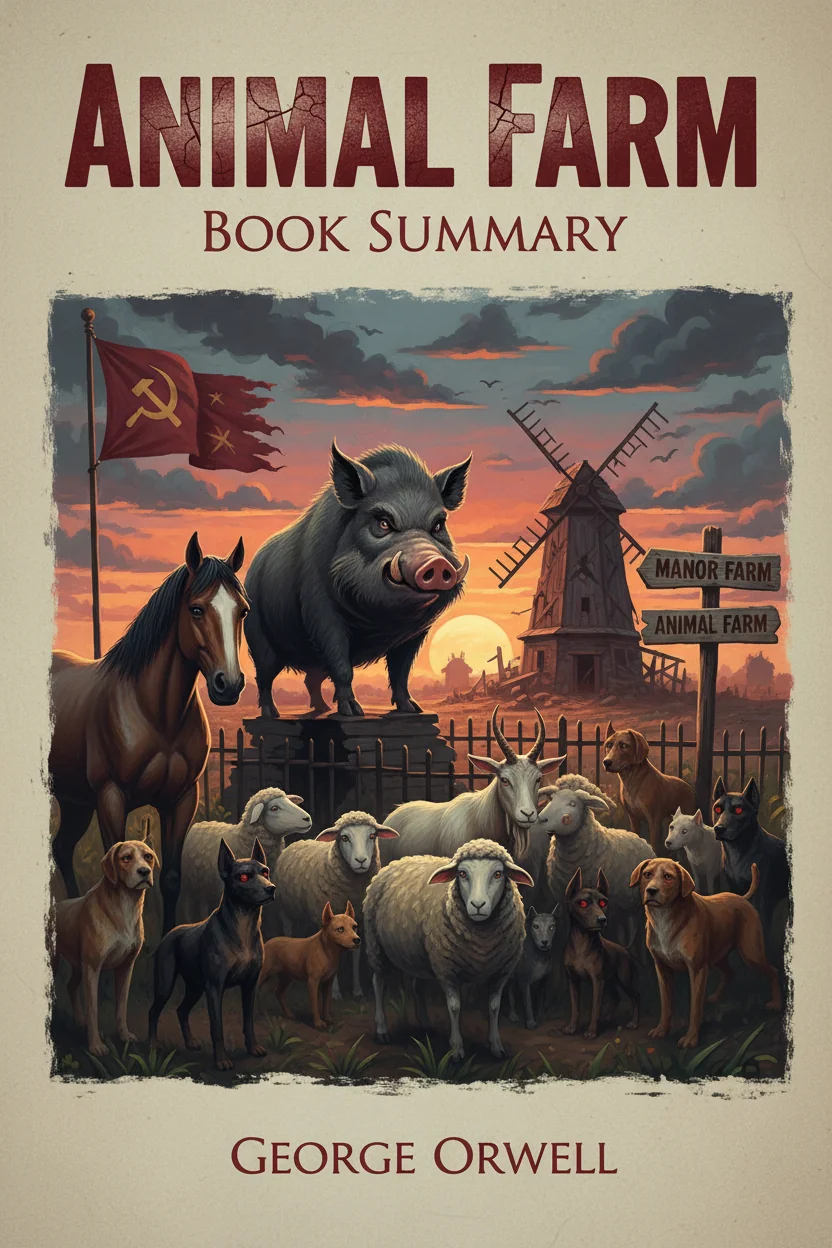
La Ferme des animaux
par Alex Ng
« La Ferme des animaux » de George Orwell est un conte allégorique dénonçant le totalitarisme. L'histoire suit un groupe d'animaux qui chassent leur propriétaire humain pour instaurer une société égalitaire, pour finalement voir s'installer un régime tyrannique dirigé par leurs propres semblables, illustrant ainsi la trahison des idéaux révolutionnaires.
L'idée principale
"Le pouvoir corrompt, et le pouvoir absolu corrompt absolument : les révolutions ne font souvent que remplacer une tyrannie par une autre."
Aperçus clés
The Cycle of Revolution
Revolutions that promise equality often end with new elites replacing old ones. The oppressed can become oppressors when they gain power.
The pigs begin as liberators fighting for animal equality, but gradually adopt the very behaviors they once condemned in humans.
The Power of Propaganda
Those in power control the narrative. By manipulating language and history, rulers can make the population accept—even embrace—their own oppression.
Squealer constantly revises the Seven Commandments and rewrites history, until the animals can no longer remember what they originally fought for.
The Danger of Blind Loyalty
Unquestioning loyalty to leaders or ideologies enables tyranny. Critical thinking and healthy skepticism are essential safeguards against manipulation.
Boxer's motto 'Napoleon is always right' leads him to work himself to death while the pigs exploit his loyalty.
The Corruption of Language
Controlling language means controlling thought. When words are twisted, people lose the ability to recognize or articulate injustice.
The commandment 'All animals are equal' becomes 'All animals are equal, but some animals are more equal than others.'
The Importance of Education
An uneducated population is easy to manipulate. The pigs maintain power partly because they're the only ones who can read and understand complex ideas.
The other animals can't verify what the pigs tell them about their own laws and history because they never learned to read properly.
Détail des chapitres
The Story
The Rebellion
Manor Farm is run by the cruel and often drunk Mr. Jones. Old Major, a wise pig, inspires the animals with a vision of freedom and equality. After Old Major dies, the animals revolt, drive out Jones, and rename the farm "Animal Farm."
The Seven Commandments
The pigs establish seven commandments, including "All animals are equal" and "No animal shall kill any other animal." These rules are meant to ensure a just society different from human tyranny.
The Rise of the Pigs
Two pigs emerge as leaders: Napoleon (cunning and ruthless) and Snowball (idealistic and innovative). After a power struggle, Napoleon uses his trained dogs to chase Snowball away, seizing sole control.
The Gradual Corruption
Under Napoleon's rule, the commandments are gradually modified. The pigs move into the farmhouse, sleep in beds, drink alcohol, and walk on two legs—all things originally forbidden. Squealer, the propaganda pig, convinces the other animals that their memories are wrong.
The Final Betrayal
The novel ends with the pigs hosting a dinner with neighboring human farmers. The other animals look through the window and can no longer distinguish between the pigs and the humans they once overthrew.
Historical Allegory
Orwell wrote Animal Farm as a critique of the Soviet Union under Stalin:
- Old Major = Marx/Lenin (the revolutionary idealist)
- Napoleon = Stalin (the ruthless dictator)
- Snowball = Trotsky (the exiled rival)
- Squealer = State propaganda
- Boxer = The loyal working class
- The Dogs = Secret police
Timeless Relevance
While the allegory is specific to Soviet communism, the themes are universal. Animal Farm warns against any system where power becomes concentrated and unaccountable—a message that remains relevant across political contexts.
Passer à l'action
Étapes pratiques à mettre en œuvre dès aujourd'hui :
-
Question authority and verify claims, especially from those in power
-
Pay attention to how language is used to frame issues and shape perception
-
Support education and critical thinking in your community
-
Be wary of leaders who demand blind loyalty or discourage questioning
-
Remember that intentions don't guarantee outcomes—systems can corrupt good people
À qui s'adresse ce texte
Toute personne s'intéressant à la philosophie politique et aux dynamiques de pouvoir. Les amateurs d'allégories et de critiques sociales. Les étudiants étudiant le totalitarisme ou la propagande. Ceux qui recherchent un classique court mais percutant (moins de 150 pages).
Résumé écrit par
Software Engineer & Writer
Software engineer with a passion for distilling complex ideas into actionable insights. Writes about finance, investment, entrepreneurship, and technology.
Voir tous les résumés →Avis
Pas encore d'avis. Soyez le premier à partager vos impressions !