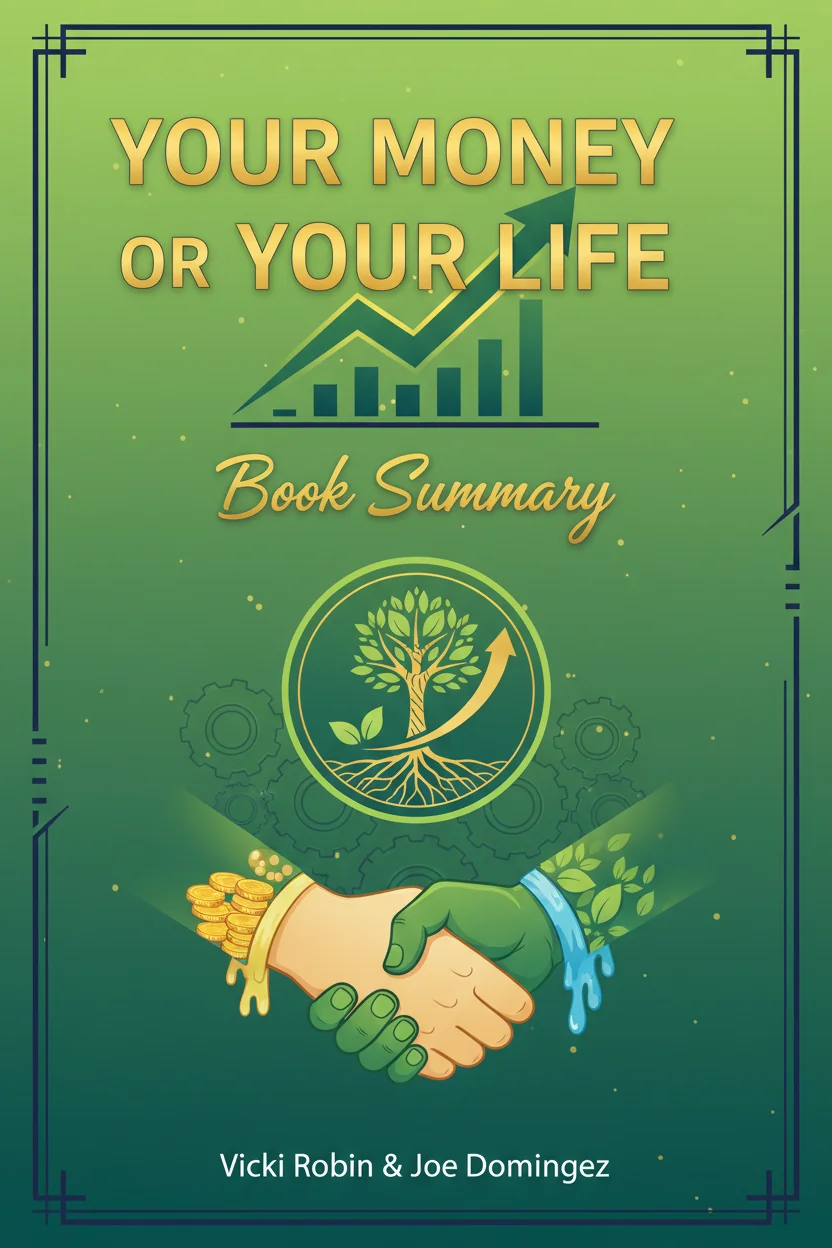
Your Money or Your Life
by Alex Ng
Vicki Robin and Joe Dominguez’s transformative guide to achieving financial independence by redefining your relationship with money.
The Big Idea
"Financial independence isn't about getting rich—it's about aligning your spending with your values and reclaiming your life energy."
Key Insights
Money = Life Energy
Money represents the hours of your life you traded to earn it. When you spend money, you're really spending your life energy. This reframe transforms how you think about every purchase.
If you earn $20/hour after taxes, a $100 dinner costs 5 hours of your life. Is that meal worth 5 hours of work?
The Fulfillment Curve
Spending increases happiness only up to a point (survival → comforts → luxuries). Beyond 'enough,' more spending actually decreases life satisfaction.
A basic reliable car provides transportation. A luxury car might briefly increase status, but the extra cost rarely brings proportional fulfillment.
Track Every Penny
Awareness is the first step to change. Tracking all income and expenses reveals unconscious spending patterns and enables conscious choices.
Many people discover they spend hundreds monthly on subscriptions, impulse purchases, or convenience items they barely use or enjoy.
The Crossover Point
Financial independence occurs when your investment income exceeds your monthly expenses. This is your 'crossover point'—work becomes optional.
If your monthly expenses are $3,000 and your investments generate $3,000+ passively, you've reached financial independence.
Redefine Work and Purpose
Once financially independent, you can pursue meaningful work regardless of pay. Many people discover their calling when money is no longer the primary motivator.
Authors chose to live frugally so they could dedicate their lives to teaching financial independence rather than working corporate jobs.
Chapter Breakdown
The 9-Step Program to Financial Independence
Step 1: Making Peace with the Past
Calculate how much money you've earned in your lifetime and assess your current net worth. This exercise reveals whether your spending has aligned with your values.
Step 2: Being in the Present—Tracking Your Life Energy
Determine your real hourly wage by factoring in all work-related expenses and time. This gives you a true picture of what your work costs you.
Step 3: Monthly Tabulation
Track every penny that comes into or goes out of your life. Create categories that are meaningful to you, not generic budget categories.
Step 4: Three Questions That Will Transform Your Life
- Did I receive fulfillment proportional to life energy spent?
- Is this expenditure aligned with my values and life purpose?
- How would this change if I didn't have to work for money?
Step 5: Making Life Energy Visible
Create a large wall chart showing your total monthly income and expenses. Watching these lines over time creates powerful motivation and awareness.
Step 6: Valuing Your Life Energy—Minimizing Spending
Learn to spend less while enjoying life more. Focus on getting maximum fulfillment per dollar spent by being conscious of the fulfillment curve.
Step 7: Valuing Your Life Energy—Maximizing Income
Increase your income through better negotiation, career moves, or side ventures. The goal isn't maximum income—it's optimal income for your life.
Step 8: Capital and the Crossover Point
As your expenses decrease and investments grow, track your investment income on your wall chart. The crossover point is when investment income exceeds expenses.
Step 9: Managing Your Finances
Once you reach the crossover point, manage your capital to provide consistent income. The authors recommend safe, long-term investments like treasury bonds (though many modern readers prefer index funds).
Core Philosophy
The book challenges the "more is better" mentality and asks fundamental questions: What is money? What is enough? What would you do if you didn't have to work? By treating money as life energy, readers gain a powerful framework for making financial decisions aligned with their true values.
Take Action
Practical steps you can implement today:
-
Calculate your real hourly wage (subtract commute, work clothes, decompression time)
-
Track every penny for one month to understand your actual spending
-
Ask three questions before each purchase: Did I receive fulfillment? Is this aligned with my values? Would I buy this if I were already financially independent?
-
Create a wall chart showing your income, expenses, and investment income over time
-
Calculate your crossover point and create a plan to reach it
-
Invest in low-cost index funds for passive income generation
Who Should Read This
Anyone feeling trapped in the work-spend cycle. People seeking financial independence or early retirement. Those who want to align their money with their values. Readers interested in the FIRE (Financial Independence, Retire Early) movement.
Summary Written By
Software Engineer & Writer
Software engineer with a passion for distilling complex ideas into actionable insights. Writes about finance, investment, entrepreneurship, and technology.
View all summaries →Reviews
No reviews yet. Be the first to share your thoughts!