Why Nation Fail
by Alex Ng
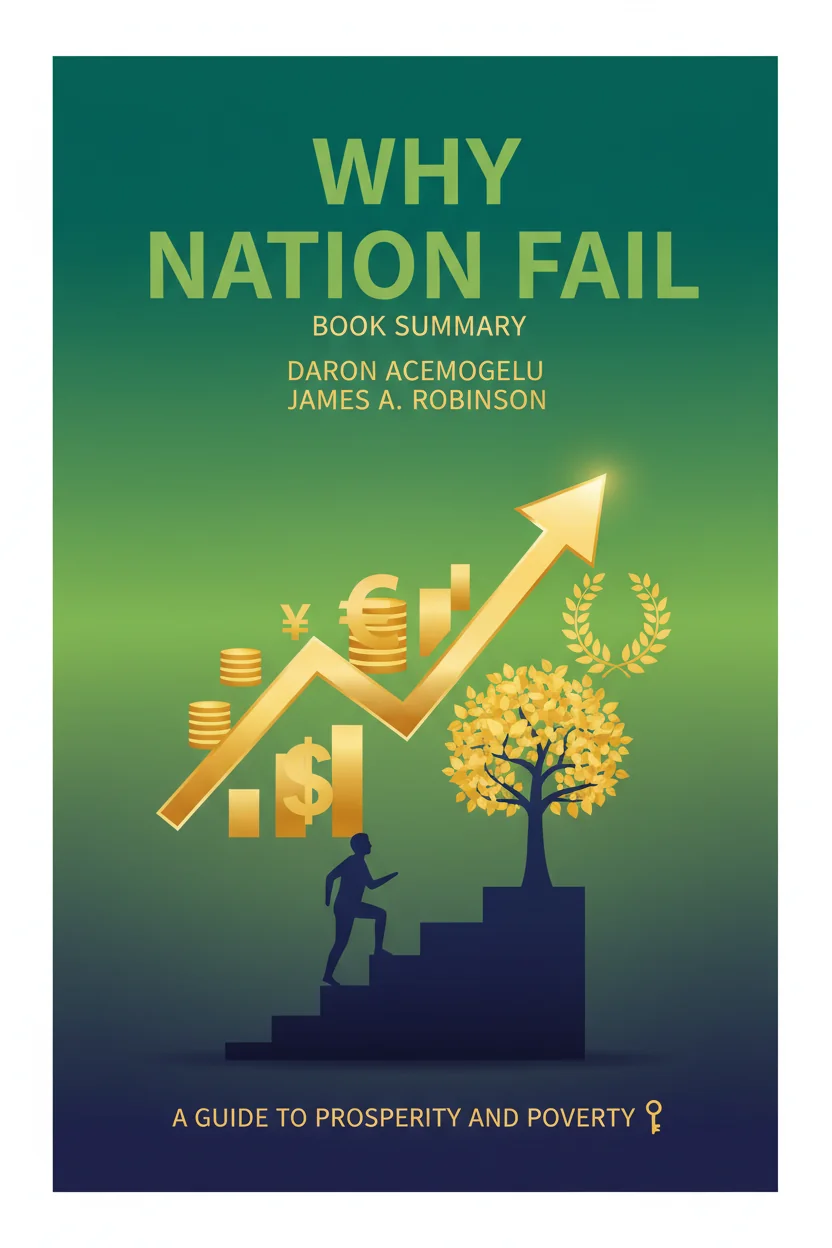
“Why Nations Fail” by Acemoglu and Robinson examines the deep-rooted factors influencing nations’ prosperity or poverty. It argues that inclusive political and economic institutions foster success, while extractive ones lead to failure, blending historical examples and economic theory to explain the divergence in global economic fortunes.
The Big Idea
"National prosperity isn't determined by geography, culture, or natural resources—it's determined by institutions. Inclusive economic and political institutions create prosperity; extractive institutions create poverty, regardless of other factors."
Key Insights
Inclusive vs Extractive Institutions
Inclusive institutions spread power broadly, protect property rights, and allow people to benefit from their own work and innovation. Extractive institutions concentrate power, expropriate wealth, and prevent most people from participating in or benefiting from economic activity.
North and South Korea started identical after WWII. South Korea developed inclusive institutions allowing entrepreneurship and innovation; North Korea's extractive institutions concentrated wealth among elites. Today, South Korean income is 20x North Korean.
Critical Junctures Change History
Small institutional differences matter hugely when 'critical junctures' occur—moments of crisis or opportunity. Similar events (like the Black Death or colonial conquest) can push societies in very different directions depending on their starting institutions.
The Black Death created labor shortages everywhere in Europe. In Western Europe, this gave peasants bargaining power, weakening feudalism. In Eastern Europe, elites responded by strengthening serfdom. Same shock, opposite institutional outcomes.
Geography and Culture Don't Determine Success
The authors systematically debunk theories that blame poverty on geography (climate, disease), culture (work ethic, values), or ignorance (leaders don't know better). Nogales, Arizona and Nogales, Mexico share geography and culture but have vastly different outcomes—the difference is their institutions.
The same people, separated only by a border, have dramatically different living standards. African countries with abundant resources often fare worse than resource-poor countries. Culture doesn't explain why West Germany prospered while East Germany stagnated.
Political Institutions Drive Economic Institutions
Economic institutions that create prosperity cannot exist without political institutions that distribute power broadly. Extractive political institutions will eventually undermine any economic progress because those in power will extract wealth rather than allow others to accumulate it.
China's recent growth comes from partial economic inclusion—allowing markets and entrepreneurship. But without political inclusion, elites can still extract wealth and block competition. The authors predict limits to this model without political reform.
Creative Destruction Threatens Elites
Economic progress requires 'creative destruction'—new technologies and businesses displacing old ones. Elites fear this because it threatens their position. Throughout history, ruling classes have blocked innovation to protect themselves, impoverishing their nations.
The Austrian and Russian Emperors banned railroads, fearing social change. Chinese emperors banned ocean-going ships. British textile magnates tried to block new manufacturing methods. Fear of creative destruction keeps nations poor.
Chapter Breakdown
The Central Argument
Acemoglu and Robinson argue that national prosperity is determined by institutions—the rules and norms that structure economic and political life. Some institutions are "inclusive": they spread opportunity broadly, protect property rights, and allow innovation. Others are "extractive": they concentrate power and wealth among elites while excluding most people.
This explains why nations with similar geography, culture, and history can have wildly different outcomes. North and South Korea started identical; their divergence is entirely institutional.
Debunking Alternative Theories
Geography hypothesis: Tropical climates and disease burden don't explain poverty. Singapore and Hong Kong thrive despite hot climates; Argentina's temperate climate didn't prevent economic decline.
Culture hypothesis: "Protestant work ethic" doesn't explain why Catholic countries like Italy were once richer than Protestant England. Culture changes with institutions, not the reverse.
Ignorance hypothesis: Leaders often know what policies would help their nations. They don't implement them because those policies would threaten their power. Bad policies aren't mistakes—they're features of extractive systems.
The Role of History
Institutional differences often trace back to historical "critical junctures"—moments when events could have gone either way. The Black Death, colonial encounters, and revolutions created divergent paths depending on existing institutional structures.
Colonialism illustrates this dramatically. In areas where colonizers could settle (like North America), they created inclusive institutions for themselves. In areas too disease-ridden for settlement (like Congo), they created purely extractive systems. These colonial institutions persisted long after independence.
Why Extractive Institutions Persist
Elites benefit from extractive institutions and fight to maintain them. They fear "creative destruction"—the economic change that accompanies innovation—because it threatens their position. Throughout history, ruling classes have blocked technologies and reforms that would have enriched their nations but weakened their grip.
This creates a vicious cycle: extractive institutions impoverish nations, but the elites who benefit from them remain powerful enough to resist change. Breaking this cycle usually requires a critical juncture that shifts power.
The Implications
The authors are cautiously optimistic but acknowledge the difficulty of institutional change. Foreign aid often fails because it doesn't address institutional problems. Economic growth under extractive institutions (like China's) may hit limits without political reform. Sustainable prosperity requires inclusive political and economic institutions together.
Take Action
Practical steps you can implement today:
-
When analyzing why some places prosper and others don't, look at institutions first—not geography, culture, or resources
-
Support reforms that distribute power more broadly and protect property rights for everyone, not just elites
-
Recognize that economic freedom without political freedom has limits—concentrated political power eventually extracts economic gains
-
Embrace creative destruction in your own life and organizations, even when it's uncomfortable
-
Understand that small institutional changes during critical moments can compound into massive differences over time
Summary Written By
Software Engineer & Writer
Software engineer with a passion for distilling complex ideas into actionable insights. Writes about finance, investment, entrepreneurship, and technology.
View all summaries →Reviews
No reviews yet. Be the first to share your thoughts!