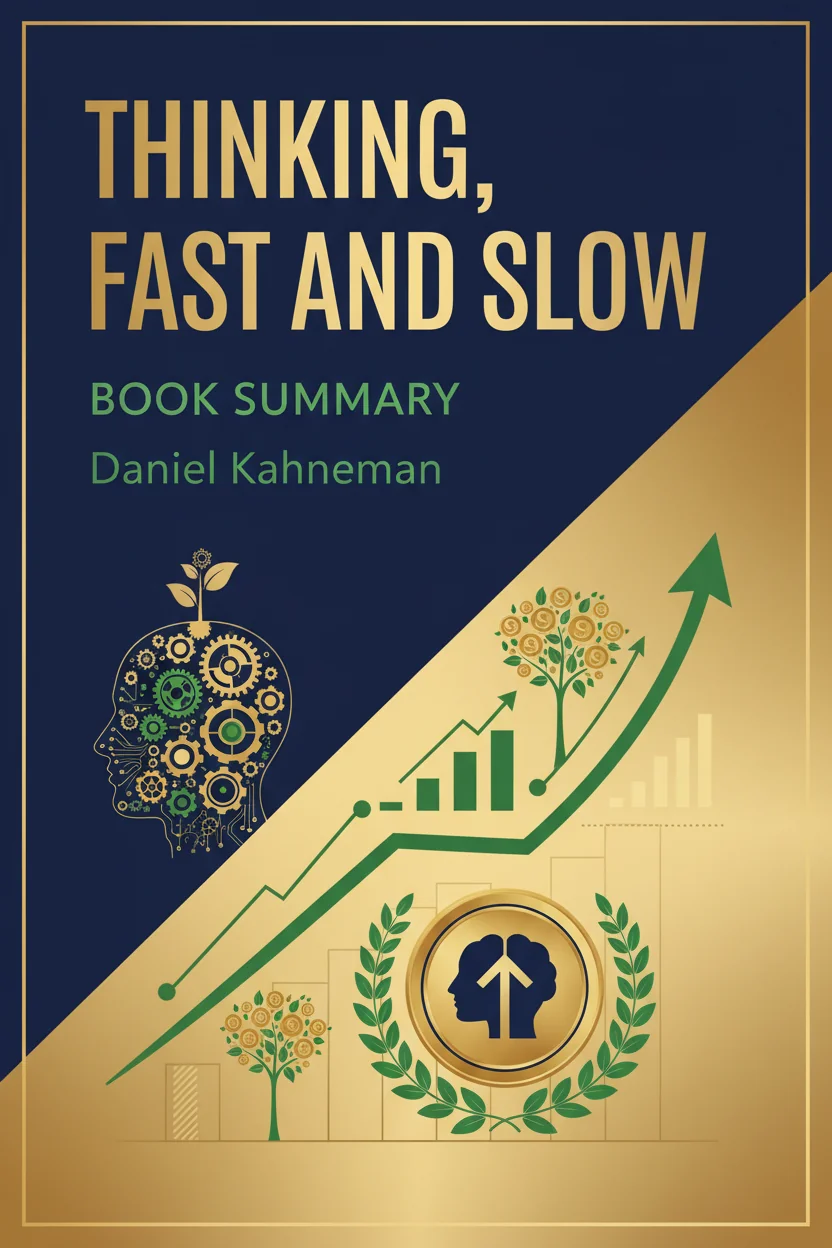
Thinking, Fast and Slow
by Alex Ng
Nobel Prize winner Daniel Kahneman’s groundbreaking exploration of how the human mind makes decisions.
The Big Idea
"Our minds operate through two systems: fast, intuitive System 1 and slow, deliberate System 2—and understanding their interplay reveals why we make predictable errors in judgment and how we might think more clearly."
Key Insights
System 1 vs System 2
System 1 operates automatically, quickly, with little effort and no sense of voluntary control. System 2 allocates attention to effortful mental activities requiring concentration. We identify with System 2, but System 1 does most of the work.
When you see '2 + 2 = ?', the answer comes automatically (System 1). When you see '17 × 24 = ?', you must deliberately calculate (System 2). Most of our daily decisions are made by the automatic system, for better or worse.
Cognitive Biases Are Predictable
System 1 uses mental shortcuts (heuristics) that usually work well but systematically produce errors in specific situations. These errors aren't random—they're predictable biases that affect everyone, even experts who know about them.
Anchoring bias: when asked if Gandhi died before or after age 114, people then estimate his age at death higher than those asked about age 35. The initial number—even if irrelevant—anchors subsequent judgments.
What You See Is All There Is (WYSIATI)
System 1 constructs coherent stories from available information without considering what information might be missing. It doesn't pause to ask what it doesn't know. This explains overconfidence: we're confident because we've built a good story, not because we have complete information.
You meet someone charming at a party and conclude they'd be a good business partner. System 1 built a coherent impression from limited data. You didn't consider that charm at parties tells you nothing about business competence.
Loss Aversion: Losses Loom Larger
Losing $100 feels about twice as painful as gaining $100 feels good. This asymmetry means we're often irrationally risk-averse for gains and risk-seeking to avoid losses. Loss aversion explains phenomena from stock market behavior to why people stay in bad jobs.
People refuse a coin flip where they'd win $110 or lose $100, even though the expected value is positive. The potential loss feels too painful, even when the odds favor taking the bet.
Experiencing Self vs Remembering Self
There are two selves: the experiencing self who lives in the present moment, and the remembering self who constructs the story of your life. They value things differently. The remembering self cares about peaks and endings, not duration.
A two-week vacation with great moments and a poor ending is remembered worse than a one-week vacation that ended well. The remembering self, which makes decisions, overweights endings and ignores duration.
Chapter Breakdown
Two Systems of Thinking
Kahneman, a Nobel Prize-winning psychologist, presents decades of research on how humans actually think—and how that differs from how we believe we think. His central framework divides cognition into two systems:
System 1 is fast, automatic, intuitive, and emotional. It operates effortlessly and generates impressions, feelings, and quick judgments. It's always running, always generating suggestions for System 2.
System 2 is slow, deliberate, logical, and effortful. It's what we identify as "thinking"—the voice in our head that considers, calculates, and decides. But System 2 is lazy; it often accepts System 1's suggestions without examination.
Cognitive Biases
System 1's shortcuts usually work well, but they create systematic errors—cognitive biases—in predictable situations:
- Anchoring: First numbers encountered bias subsequent estimates
- Availability: We judge frequency by how easily examples come to mind
- Representativeness: We ignore base rates in favor of how well something fits a stereotype
- Framing: The same information produces different decisions based on how it's presented
These biases aren't character flaws—they're features of how human cognition evolved. Understanding them doesn't make you immune, but it can make you more cautious.
Prospect Theory and Loss Aversion
Kahneman and Tversky's prospect theory, which won the Nobel Prize, describes how people actually make decisions under uncertainty. Key findings include:
- Losses loom larger than gains (about 2:1)
- We evaluate outcomes relative to reference points, not absolute states
- We're risk-averse for gains but risk-seeking to avoid losses
This explains behaviors that puzzle traditional economists: why people won't sell stocks at a loss, why they hold losing positions hoping to break even, why they reject favorable gambles.
Two Selves
The experiencing self lives in moments; the remembering self constructs narratives. Crucially, the remembering self makes decisions about the future. But it judges experiences by their peak intensity and their ending, largely ignoring duration.
This "peak-end rule" has profound implications: a shorter vacation with a great ending may be remembered more fondly than a longer one. Pain that diminishes is remembered better than steady pain. We plan our lives for the remembering self, not the experiencing self.
Take Action
Practical steps you can implement today:
-
When making important decisions, slow down and engage System 2 rather than trusting your first intuition
-
Ask 'What information am I missing?' before drawing conclusions—fight the WYSIATI tendency
-
Be aware that losses feel twice as bad as equivalent gains feel good; don't let loss aversion keep you in bad situations
-
Consider base rates before being swayed by vivid stories or recent examples
-
For experiences you want to remember fondly, engineer good endings—your remembering self will thank you
Summary Written By
Software Engineer & Writer
Software engineer with a passion for distilling complex ideas into actionable insights. Writes about finance, investment, entrepreneurship, and technology.
View all summaries →Reviews
No reviews yet. Be the first to share your thoughts!