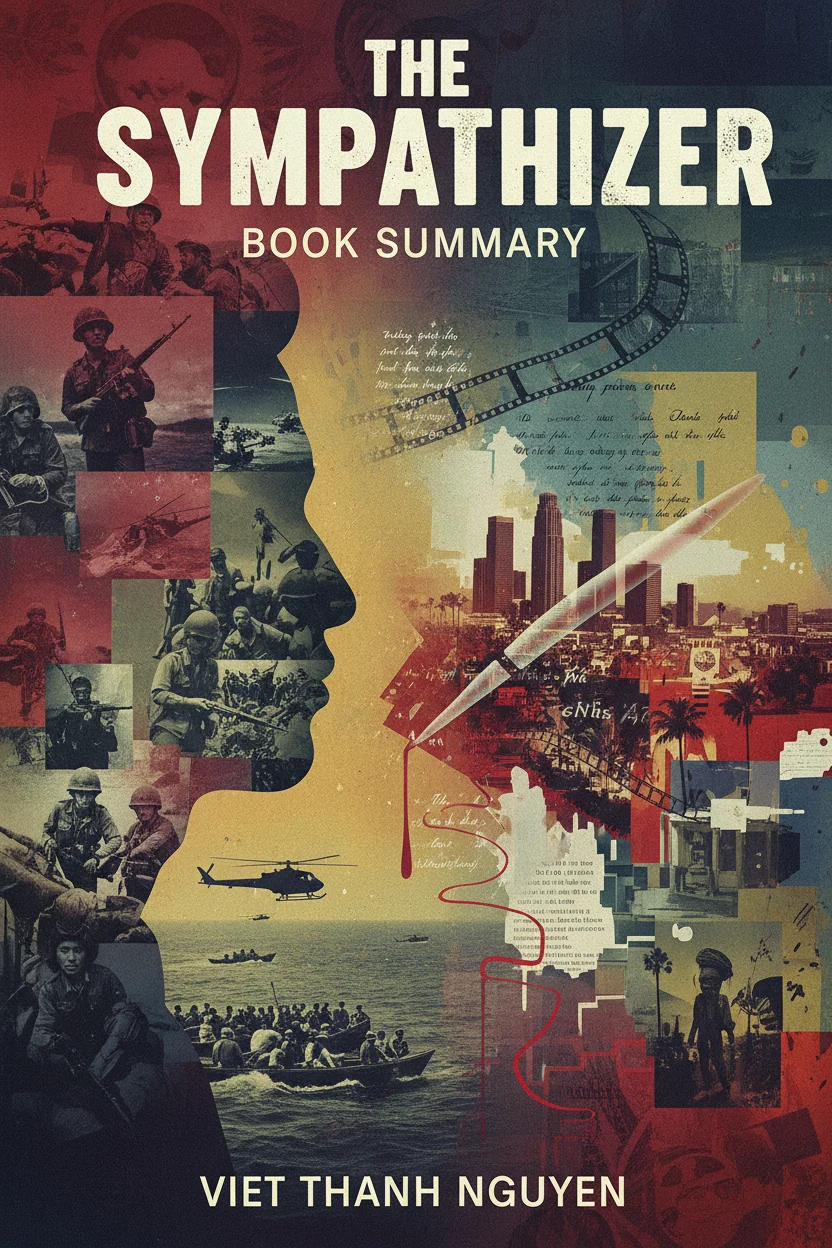
The Sympathizer
by Alex Ng
“The Sympathizer” by Viet Thanh Nguyen is a gripping tale of espionage, identity, and divided loyalty. Set during and after the Vietnam War, it follows a communist spy grappling with his dual heritage, political ideology, and the moral complexities of war, offering a fresh perspective on a tumultuous historical era.
The Big Idea
"Identity is never singular—the 'man of two minds' represents anyone caught between cultures, ideologies, or allegiances, forced to betray something no matter which side they choose."
Key Insights
The Spy as Metaphor for the Immigrant
The narrator's position as a double agent mirrors the experience of immigrants and biracial people everywhere—forced to navigate between two worlds, belonging fully to neither, translating between cultures that often misunderstand each other.
The narrator describes himself as 'a man of two minds,' half-French and half-Vietnamese, communist yet employed by capitalists. This dual consciousness is both his gift and his curse—he sees what others miss but belongs nowhere.
There Are No Clean Sides in War
The novel refuses to paint either the Americans or the Communists as purely good or evil. Both sides commit atrocities. Both sides believe in their cause. The narrator's position lets him see the compromises and brutalities of both, denying readers the comfort of easy moral judgments.
The narrator helps the CIA-backed South Vietnamese while secretly reporting to the Communists. He witnesses American bombings and Vietnamese reeducation camps. Neither side emerges as morally superior—war corrupts everyone.
Memory and Storytelling Shape Truth
The novel is structured as a confession, highlighting how the stories we tell about ourselves and our history are always shaped by power, perspective, and the audience we're addressing. There is no objective account of war—only competing narratives.
The narrator writes his confession for a Communist commander, knowing his audience will judge certain details. He's also critiquing American movies about Vietnam, showing how Hollywood told stories that erased Vietnamese perspectives.
The Cost of Radical Commitment
Total commitment to any ideology requires sacrificing parts of yourself—friends, loyalties, even your own humanity. The narrator's devotion to the revolution costs him everyone he loves and ultimately his sense of self.
The narrator must betray his mentor General, inform on his refugee compatriots, and ultimately participate in the death of his closest friend. His ideological commitment leaves him with nothing but guilt and emptiness.
Comedy and Horror Coexist
The novel's darkly comic tone captures something true about how humans process trauma and absurdity. Horror becomes bearable through black humor; comedy doesn't diminish tragedy but makes it survivable.
Scenes of genuine horror—murders, torture, reeducation camps—are narrated with ironic wit. This isn't callousness but survival: the only way to describe the indescribable is to acknowledge its absurdity.
Chapter Breakdown
The Confession
The novel is structured as a confession written by an unnamed narrator in a Vietnamese reeducation camp. He addresses a Communist commandant, recounting his life as a double agent during the fall of Saigon, his escape to America as a refugee, and his eventual return to Vietnam.
The confession framework creates multiple layers of unreliability. The narrator selects, emphasizes, and shapes his story for his audience. We're never certain what's true, what's strategic, and what's self-deception.
A Man of Two Minds
The narrator is the illegitimate son of a French priest and a Vietnamese woman. He was educated in America, works as a captain in the South Vietnamese army, but is secretly a Communist spy. His position gives him insight into multiple worlds while belonging to none.
This double consciousness is both his greatest asset and his deepest wound. He can see what others miss—the blindspots of American liberalism, the brutality of Communist revolution, the corruption on all sides. But he can never rest, never stop performing, never simply be.
The Fall and After
The first section follows the final days of Saigon, the narrator's evacuation with the General (his boss and unknowing target), and their resettlement in Los Angeles. As a spy among refugees, the narrator reports on his community while simultaneously genuinely caring for them.
The American sections satirize immigrant experience: the humiliations of starting over, the stereotype of Asians as perpetual foreigners, and Hollywood's self-serving depictions of Vietnam. The narrator works as a consultant on an "Apocalypse Now"-style film that erases Vietnamese perspectives from their own story.
Return and Reckoning
Eventually, the narrator participates in a doomed mission back to Vietnam, is captured, and enters reeducation. There he must confront what his double life has cost—the friends he betrayed, the atrocities he enabled, and the impossibility of maintaining a coherent self through years of deception.
The ending is deliberately ambiguous. The narrator achieves a kind of clarity but it's unclear whether it represents enlightenment or breakdown, freedom or final defeat.
Historical Context
The novel won the 2016 Pulitzer Prize for Fiction and is widely considered the definitive Vietnamese-American novel about the Vietnam War. Nguyen, himself a refugee who arrived in America as a child, writes explicitly against the American tendency to see the war as primarily about America, insisting on Vietnamese perspectives and experiences.
Take Action
Practical steps you can implement today:
-
Recognize that immigrants and bicultural people carry the burden of constant translation between worlds—offer understanding rather than demands for 'picking a side'
-
Question simple narratives about historical conflicts; both sides of any war contain heroes and villains
-
Consider whose perspective is missing from the stories you consume—especially when those stories are told by the powerful about the less powerful
-
Reflect on what ideological commitments cost you; absolute loyalty to any cause requires betraying parts of yourself
-
Use humor and irony as survival tools for processing difficult experiences, not as ways to diminish their importance
Summary Written By
Software Engineer & Writer
Software engineer with a passion for distilling complex ideas into actionable insights. Writes about finance, investment, entrepreneurship, and technology.
View all summaries →Reviews
No reviews yet. Be the first to share your thoughts!