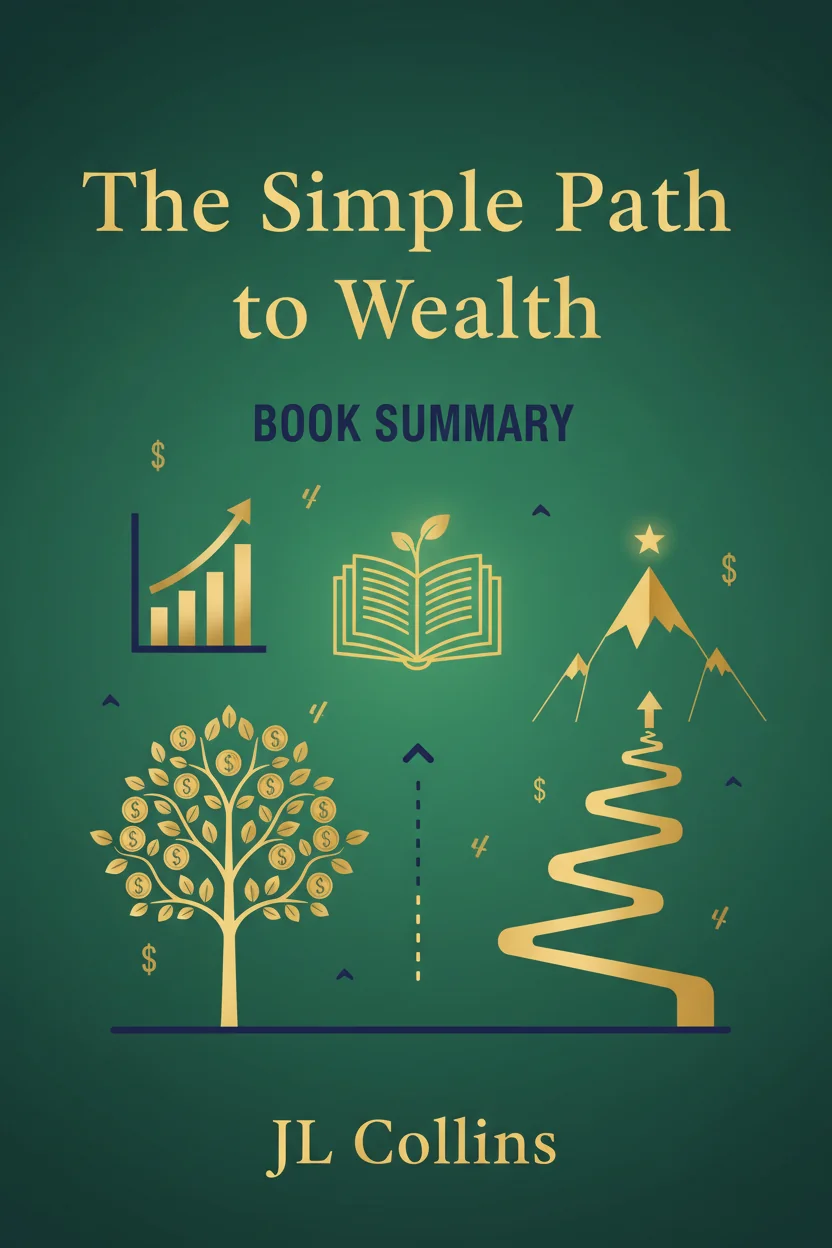
The Simple Path to Wealth
by Alex Ng
JL Collins’ clear and actionable advice for achieving financial independence through simple investing.
The Big Idea
"Financial independence is achievable for ordinary people through one simple strategy: spend less than you earn, avoid debt, and invest the difference in low-cost index funds—then let time and compound growth do the rest."
Key Insights
The Stock Market Always Goes Up (Eventually)
Despite crashes, corrections, and bear markets, the overall trajectory of the stock market is upward over time. If you can stay invested through the downturns, you'll participate in the recoveries. The market's long-term trend is your friend.
The S&P 500 has returned about 10% annually over its history. Every market crash—1929, 1987, 2008—was followed by recovery and new highs. Investors who panicked and sold missed the recovery; those who stayed in were rewarded.
VTSAX and Chill
You don't need complex strategies or stock picking. A single total stock market index fund (like VTSAX) gives you instant diversification across thousands of companies at minimal cost. This simple approach beats most professional investors over time.
From 2002-2012, 89% of actively managed funds failed to beat the S&P 500 index. The more you try to be clever with stock picking, the more likely you are to underperform. Simplicity wins.
F-You Money Means Freedom
Having enough money that you don't need your job gives you negotiating power and peace of mind. You can take risks, say no to bad deals, and make choices based on what you want rather than what you must do to survive.
Collins's 'F-You Money' isn't necessarily full retirement—it's having enough savings that losing your job wouldn't be catastrophic. This changes how you show up at work and how you make career decisions.
Debt Is an Emergency
Debt is a financial emergency that should be eliminated as quickly as possible. Interest payments are wealth flowing away from you. Every dollar of debt is a dollar working against your financial independence.
If you have credit card debt at 18% interest, paying it off is equivalent to earning an 18% guaranteed return—far better than any investment. Eliminate debt before investing beyond employer matching.
The 4% Rule for Retirement
Research shows that withdrawing 4% of your portfolio annually (adjusted for inflation) has historically survived most 30-year periods without running out of money. This gives you a target: you need 25 times your annual expenses to be financially independent.
If you need $40,000/year to live, you need $1 million invested (40,000 × 25). At a 4% withdrawal rate, you can theoretically live off your investments indefinitely while preserving principal.
Chapter Breakdown
The Simple Formula
Collins distills wealth building to a simple formula that anyone can follow: Spend less than you earn. Avoid debt. Invest the surplus in low-cost index funds. Let compound growth work over time. That's it.
The financial industry wants you to believe investing is complicated, requiring expert guidance and active management. But the evidence shows that simple index investing beats most professionals over time, costs virtually nothing, and requires no expertise.
Why Index Funds Win
An index fund simply holds all the stocks in an index (like the S&P 500 or the total stock market). It doesn't try to pick winners or time the market. This approach has three crucial advantages:
- Diversification: You own a piece of thousands of companies, spreading risk
- Low costs: No expensive managers, so more of your returns stay in your pocket
- Tax efficiency: Less trading means fewer taxable events
Studies consistently show that 80-90% of actively managed funds underperform their benchmark index over 15-year periods. The "experts" lose to the simple strategy.
The Two Phases of Wealth Building
Phase 1: The Accumulation Phase. When you're working and saving, your goal is to accumulate as much as possible in index funds. Collins recommends 100% stocks during this phase—you have time to ride out volatility, and stocks provide the best long-term returns.
Phase 2: The Preservation Phase. As you approach or enter retirement, you add bonds to reduce volatility. A common rule is your age in bonds (50% bonds at 50 years old), though Collins suggests this is overly conservative for most people.
The 4% Rule
Research (the Trinity Study and subsequent updates) shows that a 4% annual withdrawal rate from a diversified portfolio has historically survived 30-year retirement periods. This means you need approximately 25 times your annual expenses invested to be financially independent.
Example: If you spend $40,000/year, you need $1,000,000. If you spend $100,000/year, you need $2,500,000. Your FI number depends entirely on your spending, which is why frugality accelerates the path to independence.
F-You Money
Collins emphasizes the psychological value of "F-You Money"—having enough that you don't need any particular job or client. This isn't about being rude; it's about having options. When you can walk away from bad situations, you negotiate from strength.
You don't need full FI to benefit. Even six months of expenses saved changes your relationship to work. A year's worth changes it more. Each increment of savings buys more freedom and peace of mind.
Debt: The Enemy
Collins views debt as an emergency to be eliminated immediately. Consumer debt at high interest rates is financial suicide. Even "good debt" like mortgages should be minimized. Every dollar of debt is working against you; every dollar invested is working for you.
Take Action
Practical steps you can implement today:
-
Open an account with Vanguard (or similar) and invest in a total stock market index fund like VTSAX
-
Calculate your FI number: annual expenses × 25 = the amount you need invested to be financially independent
-
Eliminate all debt aggressively—it's a guaranteed return equal to the interest rate
-
Increase your savings rate above 50% if possible; the higher your savings rate, the faster you reach FI
-
Stay the course during market downturns—don't sell in a panic, because recovery always follows
Summary Written By
Software Engineer & Writer
Software engineer with a passion for distilling complex ideas into actionable insights. Writes about finance, investment, entrepreneurship, and technology.
View all summaries →Reviews
No reviews yet. Be the first to share your thoughts!