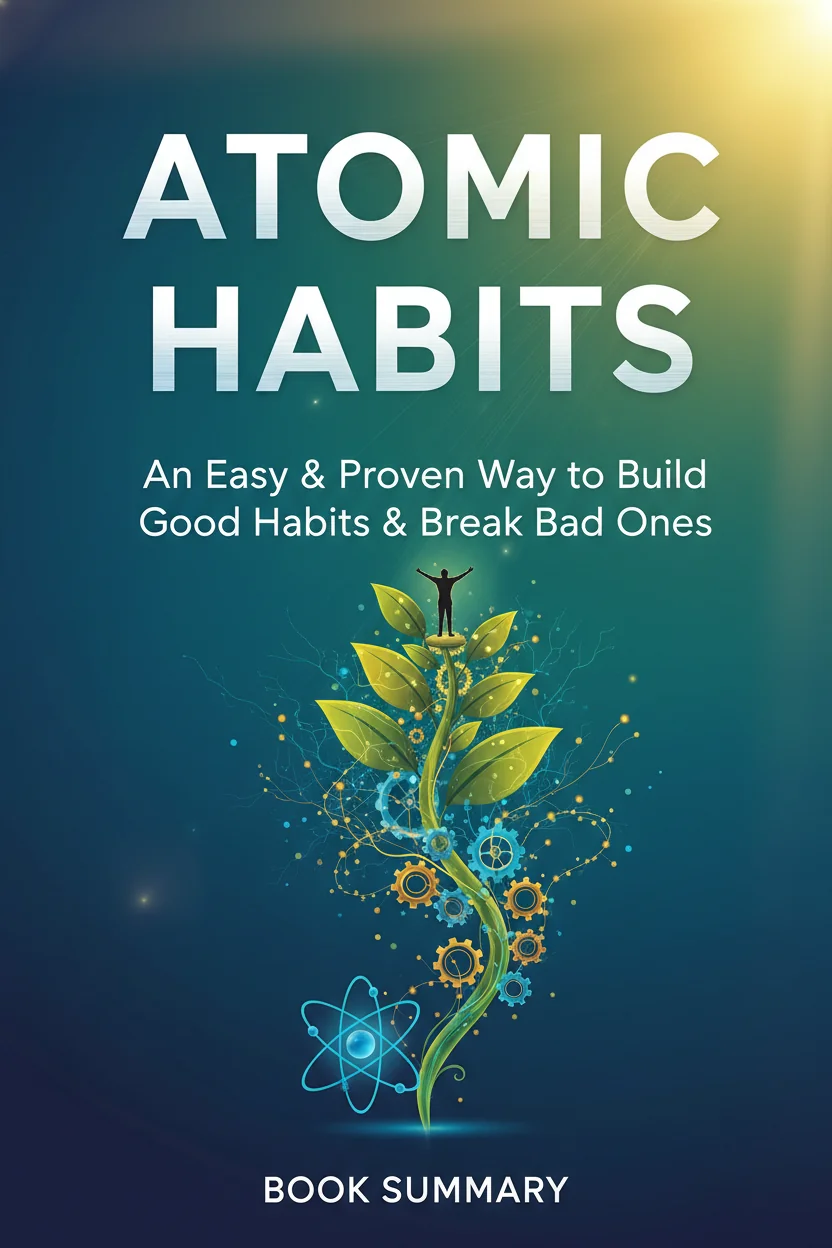
Atomic Habits: An Easy & Proven Way to Build Good Habits & Break Bad Ones
by Alex Ng
No matter your goals, Atomic Habits offers a proven framework for improving–every day. James Clear, one of the world’s leading experts on habit formation, reveals practical strategies that will teach you exactly how to form good habits, break bad ones, and master the tiny behaviors that lead to remarkable results.
The Big Idea
"Small habits, consistently applied, compound into remarkable results over time."
Key Insights
The 1% Rule
Getting 1% better every day compounds to being 37 times better after one year. Success is not about making one massive change, but about making tiny improvements consistently.
Instead of committing to 'exercise more,' start with just 2 minutes of stretching each morning. This small commitment builds the identity of someone who exercises.
Identity-Based Habits
The most effective way to change your habits is to focus on who you wish to become, not what you want to achieve. Your habits shape your identity, and your identity shapes your habits.
Don't say 'I want to read more books.' Say 'I am a reader.' Every action becomes a vote for the person you want to become.
The Four Laws of Behavior Change
Every habit follows a four-step pattern: Cue → Craving → Response → Reward. To build good habits, make them Obvious, Attractive, Easy, and Satisfying. To break bad habits, invert these laws.
Want to drink more water? Make it Obvious (keep a water bottle on your desk), Attractive (add lemon), Easy (always have it within reach), Satisfying (track your intake).
Environment Design
Your environment is the invisible hand that shapes human behavior. Rather than relying on willpower, design your environment to make good habits easier and bad habits harder.
If you want to eat healthier, place fruits at eye level in your fridge and hide junk food. If you want to read more, leave a book on your pillow.
Habit Stacking
Link new habits to existing ones using the formula: 'After [CURRENT HABIT], I will [NEW HABIT].' This leverages the momentum of existing behaviors.
After I pour my morning coffee, I will write in my gratitude journal for 2 minutes. After I sit down for dinner, I will say one thing I'm grateful for.
The Two-Minute Rule
When starting a new habit, scale it down to something that takes two minutes or less. The goal is to master the art of showing up before optimizing.
'Read before bed' becomes 'Read one page.' 'Run three miles' becomes 'Put on my running shoes.' Once you've started, continuing is much easier.
Chapter Breakdown
Part 1: The Fundamentals - Why Tiny Changes Make a Big Difference
The Surprising Power of Atomic Habits
Clear opens with his personal story of recovery from a serious injury, which led him to discover the power of small habits. The core message: habits are the compound interest of self-improvement. Getting 1% better each day compounds dramatically over time.
- Success is the product of daily habits, not once-in-a-lifetime transformations
- Your outcomes are a lagging measure of your habits
- Time magnifies the margin between success and failure
How Your Habits Shape Your Identity
There are three layers of behavior change: outcomes (results), processes (habits), and identity (beliefs). Most people focus on outcomes, but true behavior change is identity change.
- The goal is not to read a book, but to become a reader
- The goal is not to run a marathon, but to become a runner
- Every action is a vote for the type of person you wish to become
Part 2: The Four Laws of Behavior Change
The 1st Law: Make It Obvious
The process of behavior change starts with awareness. You need to make the cues of good habits obvious in your environment.
- Implementation Intentions: "I will [BEHAVIOR] at [TIME] in [LOCATION]"
- Habit Stacking: "After [CURRENT HABIT], I will [NEW HABIT]"
- Environment Design: Make the cues of good habits visible
The 2nd Law: Make It Attractive
We are more likely to find a behavior attractive if we get to do one of our favorite things at the same time.
- Temptation Bundling: Link an action you want to do with an action you need to do
- Join a culture where your desired behavior is the normal behavior
- Create a motivation ritual by doing something you enjoy before a difficult habit
The 3rd Law: Make It Easy
The most effective form of learning is practice, not planning. Focus on taking action, not being in motion.
- Reduce friction: Decrease the number of steps between you and good habits
- Prime your environment: Prepare your environment to make future actions easier
- The Two-Minute Rule: Scale down habits until they can be done in two minutes
The 4th Law: Make It Satisfying
We are more likely to repeat a behavior when the experience is satisfying. The cardinal rule: What is rewarded is repeated. What is punished is avoided.
- Use reinforcement: Give yourself an immediate reward when you complete your habit
- Habit tracking: Track your habits and "don't break the chain"
- Never miss twice: If you miss one day, get back on track immediately
Part 3: Advanced Tactics - How to Go from Good to Great
The Truth About Talent
Genes do not determine your destiny, but they do determine your areas of opportunity. Choose habits that suit your natural abilities.
The Goldilocks Rule
Humans experience peak motivation when working on tasks that are right on the edge of their current abilities - not too hard, not too easy.
The Downside of Creating Good Habits
The upside of habits is efficiency; the downside is that you can become complacent. Establish a system for reflection and review to ensure continuous improvement.
Take Action
Practical steps you can implement today:
-
Pick one habit you want to build and reduce it to a 2-minute version
-
Use habit stacking: 'After [current habit], I will [new habit]'
-
Redesign your environment to make good habits obvious and bad habits invisible
-
Track your habits with a simple calendar or app - don't break the chain
-
Join a community where your desired behavior is the normal behavior
-
Create an implementation intention: 'I will [BEHAVIOR] at [TIME] in [LOCATION]'
Summary Written By
Software Engineer & Writer
Software engineer with a passion for distilling complex ideas into actionable insights. Writes about finance, investment, entrepreneurship, and technology.
View all summaries →Reviews
No reviews yet. Be the first to share your thoughts!