Early Life in Corsica
Napoleon Bonaparte was born on August 15, 1769, in Ajaccio, Corsica, just one year after the island was transferred from the Republic of Genoa to France. He was the fourth of eleven children born to Carlo Bonaparte, a lawyer, and Letizia Ramolino.
Corsican Identity
Napoleon grew up speaking Corsican and Italian, learning French only after being sent to mainland France for education. Throughout his early years, he harbored resentment toward French rule of his homeland, though this would change as he advanced in French society.
Military Education
At age nine, Napoleon was sent to a military academy in Brienne, France. His Corsican accent and modest background made him an outsider among French aristocratic students. He excelled in mathematics and history, graduating from the prestigious École Militaire in Paris in 1785 as an artillery officer.
Rise Through the Revolution
The Siege of Toulon
Napoleon's first major opportunity came in 1793 during the siege of Toulon. When the artillery commander was wounded, the young captain took charge and devised the strategy that recaptured the port from British forces. This success earned him promotion to brigadier general at age 24.
Saving the Republic
In 1795, Napoleon defended the revolutionary government against a royalist uprising in Paris, earning the nickname "General Vendémiaire." This action brought him to the attention of the Directory, France's ruling body.
Italian Campaign (1796-1797)
At 26, Napoleon was given command of the French Army of Italy. In a brilliant campaign, he defeated Austrian and Sardinian forces, conquered much of northern Italy, and negotiated the Treaty of Campo Formio, which gave France significant territorial gains.
Development as a Commander
The Italian Campaign established Napoleon's reputation as a military genius. He demonstrated speed, surprise, and the ability to inspire troops to accomplish seemingly impossible feats.
The Egyptian Campaign (1798-1799)
Napoleon led an expedition to Egypt, hoping to threaten British interests in India. Though militarily mixed—his fleet was destroyed at the Battle of the Nile—the expedition had significant cultural impact, including the discovery of the Rosetta Stone.
Seizing Power
The Coup of 18 Brumaire
Returning to France in 1799, Napoleon participated in a coup d'état that overthrew the Directory. He became First Consul, then Consul for Life, accumulating power while maintaining a republican façade.
Emperor of the French
On December 2, 1804, Napoleon crowned himself Emperor of the French in Notre-Dame Cathedral. Pope Pius VII attended but Napoleon placed the crown on his own head, symbolizing that he owed his power to no one.
Achievements as Ruler
The Napoleonic Code
Perhaps Napoleon's most enduring legacy, the Civil Code of 1804 reformed French law. It guaranteed equality before the law, protected property rights, and separated church and state. The Code influenced legal systems worldwide.
Administrative Reforms
Napoleon reorganized France's government, establishing the Bank of France, reforming education through lycées and the University of France, and creating the Legion of Honor to recognize civil and military merit.
Military Campaigns
Grand Empire
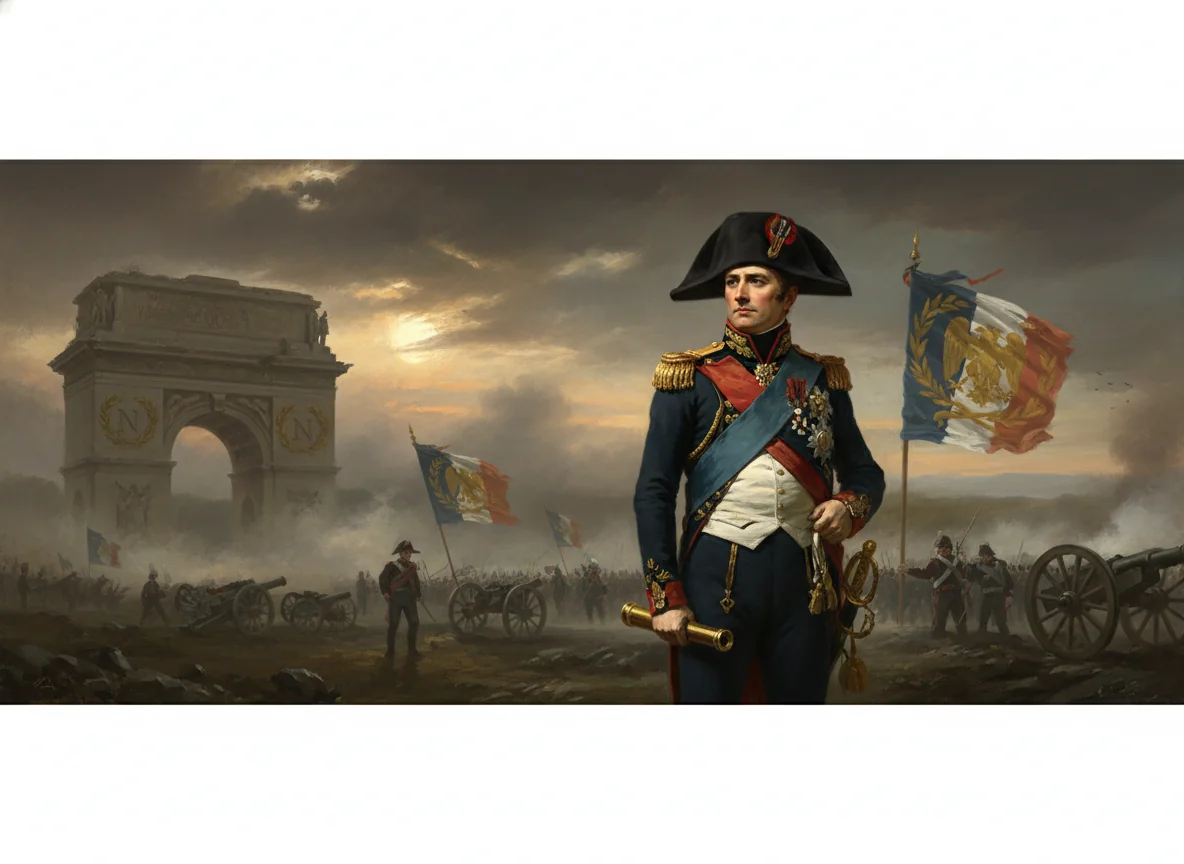
At its height in 1812, Napoleon's empire covered most of Western and Central Europe. He placed family members on thrones across the continent and reorganized territories to serve French interests.
The Russian Campaign
In 1812, Napoleon invaded Russia with over 600,000 troops. The campaign ended in disaster. Disease, starvation, and the Russian winter destroyed the Grand Army, with fewer than 100,000 returning.
Fall and Exile
First Abdication
After defeats in 1814, Napoleon abdicated and was exiled to Elba, a small island off Italy's coast. He was given sovereignty over the island and a small personal guard.
The Hundred Days
In March 1815, Napoleon escaped Elba and returned to France, beginning the Hundred Days. He quickly regained power but was decisively defeated at Waterloo in June 1815.
Saint Helena
Napoleon spent his final years in exile on Saint Helena, a remote island in the South Atlantic. He died on May 5, 1821, likely from stomach cancer, though theories of arsenic poisoning persist.
Legacy
Napoleon Bonaparte remains one of history's most studied and debated figures. His military genius revolutionized warfare, while his administrative reforms modernized governance across Europe. The Napoleonic Code influenced legal systems worldwide. Yet his wars caused immense destruction and death across the continent.
Today, Napoleon's legacy encompasses both his achievements—in law, administration, and military strategy—and the devastation his ambitions caused. He transformed Europe forever, for better and worse.