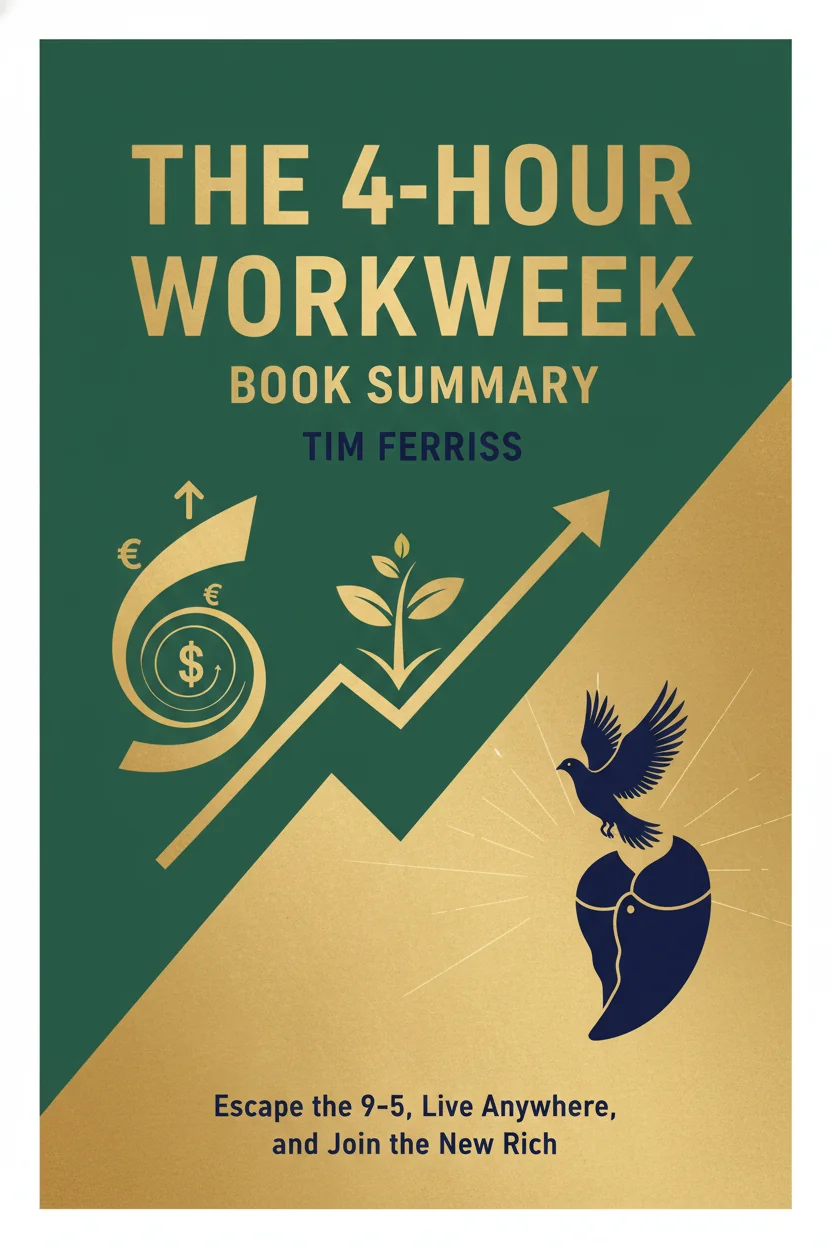
The 4-Hour Workweek
by Alex Ng
What if you could work just four hours per week while earning more money and having more freedom than traditional full-time workers? Tim Ferriss’ ‘The 4-Hour Workweek’ challenges conventional assumptions about work, retirement, and success by presenting a blueprint for ‘lifestyle design’—the art of creating a life and career around your personal goals rather than societal expectations. Published in 2007, this book became a cultural phenomenon, inspiring the digital nomad movement and changing how millions think about work-life balance. Ferriss, an entrepreneur who built and sold multiple businesses, shares his personal journey from overworked startup founder to location-independent lifestyle designer. The book introduces the concept of the ‘New Rich’ (NR)—people who abandon traditional career paths to create maximum freedom and mobility through technology, outsourcing, and systematic elimination of unnecessary work. While the literal four-hour workweek may be aspirational for most read
The Big Idea
"Retirement as a goal is flawed - both as motivation and as strategy. The goal should be lifestyle design: creating systems that generate income without requiring your constant presence, freeing you to have 'mini-retirements' throughout life rather than saving all leisure for old age."
Key Insights
The New Rich vs. The Deferrers
Ferriss distinguishes between those who defer life to retirement (Deferrers) and those who distribute mini-retirements throughout life (New Rich). The New Rich value time and mobility over money and possessions.
Working 80 hours a week for 40 years to retire at 65 makes less sense than working 20 hours a week while traveling the world for decades. Both might earn similar lifetime income, but the quality of life differs enormously.
DEAL - The Four Steps
The system is: Definition (define the lifestyle you want), Elimination (ruthlessly cut the unimportant), Automation (create systems that run without you), Liberation (escape the office and live anywhere).
A business owner might eliminate low-margin products (Elimination), hire a virtual assistant to handle customer service (Automation), and move to a country with a lower cost of living (Liberation).
Pareto and Parkinson
80% of results come from 20% of effort (Pareto). Work expands to fill the time available (Parkinson). Combining these insights: identify the 20% that matters and give yourself tight deadlines to complete only that.
Ferriss found that 80% of his income came from 20% of customers. He 'fired' the difficult 80% and focused on the valuable 20%, working less while earning more.
The Muse
A 'muse' is a simple, automated business that generates cash flow with minimal time investment. The goal isn't to build an empire but to create enough passive income to fund your lifestyle. Simple products to niche markets work best.
Ferriss built a supplements business that required only 2 hours per week once automated. It didn't make him a billionaire, but it funded years of travel and experimentation.
Chapter Breakdown
Step I: D is for Definition
Challenge the assumptions about life and work. The goal isn't retirement - it's having the freedom to do what you want, when you want. Calculate your "Target Monthly Income" - the lifestyle you actually want costs less than you think, especially if you're location-independent.
Ferriss introduces the concept of "fear-setting" - defining your worst-case scenario to realize it's not as scary as your imagination makes it.
Step II: E is for Elimination
Apply the Pareto Principle: 80% of results come from 20% of effort. Identify the vital few tasks and ruthlessly eliminate the trivial many. This includes customers, products, and activities.
Parkinson's Law states work expands to fill time available. Give yourself tight deadlines to force focus on what matters.
Batch similar tasks, check email only twice daily, and learn to say no to low-value requests.
Step III: A is for Automation
Build systems that run without you. Virtual assistants can handle routine tasks. Technology can automate customer service, order fulfillment, and even decision-making.
Create a "muse" - a simple, automated business that generates cash flow. The goal isn't a billion-dollar empire but enough income to fund your lifestyle. Information products, licensing, and niche e-commerce work well.
Step IV: L is for Liberation
Escape the office. Negotiate remote work by demonstrating higher productivity away from the office. Once remote, you're location-independent - you can live anywhere with lower costs and higher quality of life.
Take mini-retirements throughout life rather than saving all leisure for old age. Learn new languages, skills, and perspectives while you're young enough to enjoy them.
Take Action
Practical steps you can implement today:
-
Identify your 'dream lifestyle' - what would you do if you had unlimited time and money? Then calculate what it actually costs monthly
-
Apply the 80/20 rule to your work: which 20% of activities produce 80% of results? Focus only on those
-
Give yourself impossibly short deadlines for tasks - you'll find you can accomplish more in less time
-
Explore creating a simple online product for a niche market - the goal is cash flow, not scale
Summary Written By
Software Engineer & Writer
Software engineer with a passion for distilling complex ideas into actionable insights. Writes about finance, investment, entrepreneurship, and technology.
View all summaries →Reviews
No reviews yet. Be the first to share your thoughts!